An interactive maths textbook
Queen of the Sciencesfrom counting to university
Sixty-one chapters, from notches on a bone to Gödel’s theorems. Here you can touch the formulas — drag points, change numbers and watch what breaks. Every chapter opens with a problem the old tools can’t crack.
The English edition is being translated: 14 of 61 chapters are ready. The others, marked RU, open in the Russian original for now.
- 61chapters in 10 parts
- 24step-by-step problem solvers
- 4levels, from middle school to year 3
Mathematics is the queen of the sciences, and arithmetic the queen of mathematics.Gauss, as remembered by Sartorius von Waltershausen
The map of mathematics
Coloured lines are the parts of the course, stations are chapters. At each interchange one part hands over to the next, and dotted threads join chapters where an idea from one part is at work in another.
- 0Introduction
- INumbers
- IIAlgebra
- IIIGeometry
- IVCalculus
- VLinear algebra
- VIStructures
- VIIChance & data
- VIIIFoundations
- IXHorizons
- chapter
- read
- change to the next line
- an idea from one chapter at work in another
Seven big questions
The course starts with questions school rarely answers. Each of them gets its answer here.
-
Why does minus times minus make plus?
Everyone memorises the rule of signs at school. But why should a debt times a debt turn into a profit — is that a convention, or could it not be otherwise?
Answered in chapter 2 · Zero and minus -
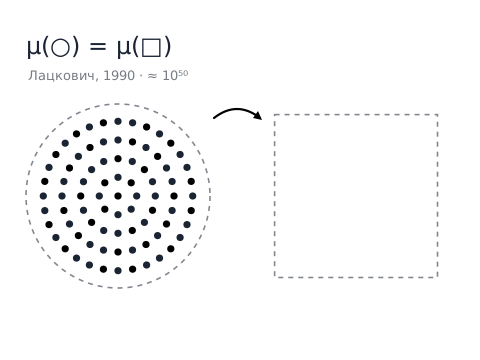
Can you cut a disc into pieces and reassemble them into a square?
Same area, different shapes. Scissors won’t do it, and neither will a compass and straightedge. Then in 1990 it turned out you can — if the pieces are ones no artist could ever draw.
Answered in chapter 54 · Measure -
Why is there no formula for the roots of a quintic?
The Babylonians could solve quadratics; cubics and quartics fell in the sixteenth century. Then nearly three hundred years of nothing — and not for lack of trying.
Answered in chapter 43 · Galois theory -
Are there more whole numbers or points on a line segment?
Both are infinite, so it seems there is nothing to compare. But infinities come in different sizes, and the proof takes a few lines.
Answered in chapter 52 · Infinities -
How does the cipher that protects your bank work?
You and your bank agree on a secret key in full view of the whole internet, and an eavesdropper still learns nothing. How is that even possible?
Answered in chapter 41 · Modular and ciphers -
Why can’t the weather be forecast a month ahead?
The equations of moving air are known and computers are fast. Yet beyond a couple of weeks forecasts give up — and it isn’t the forecasters’ fault.
Answered in chapter 59 · Chaos and fractals -
Can a statement be true but unprovable?
It seems that in mathematics everything true gets proved sooner or later. In 1931 Kurt Gödel showed otherwise — and no new axioms can fix it.
Answered in chapter 56 · Gödel and Turing -
The answers are hidden in the chapters. The first comes as early as chapter 2, where a sceptic from the 1600s argues with the rule of signs.
Start at the beginning
Chapters by part
The course reads in order, but you can open any chapter directly: each one says up front what it builds on.
Introduction
Why mathematicians prove things, and how the course works

Numbers
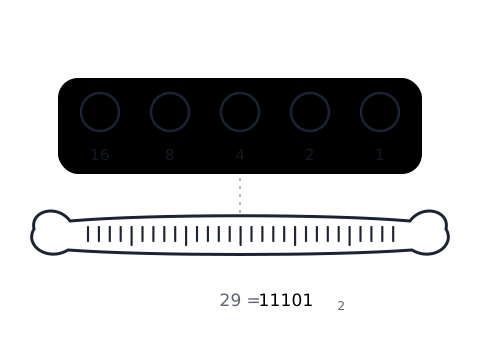
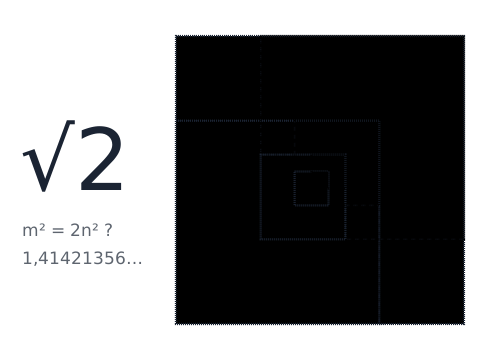
From notches on a bone to the real numbers


Algebra
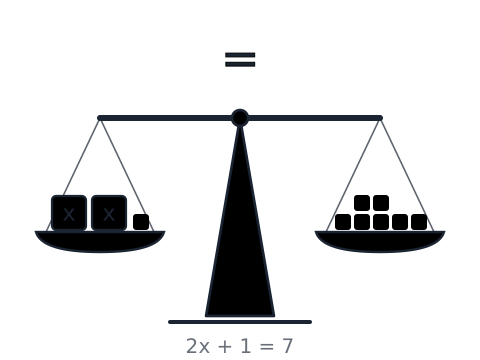
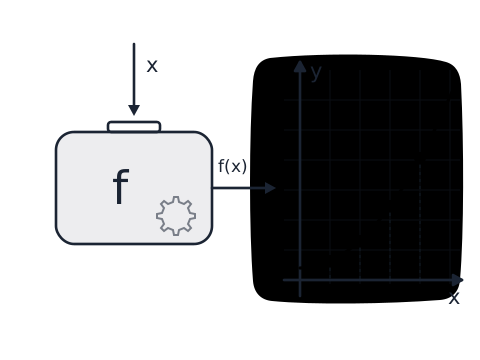
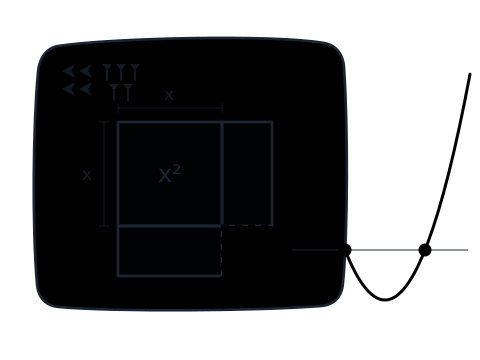
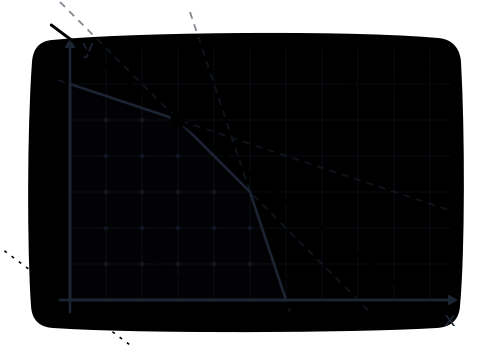
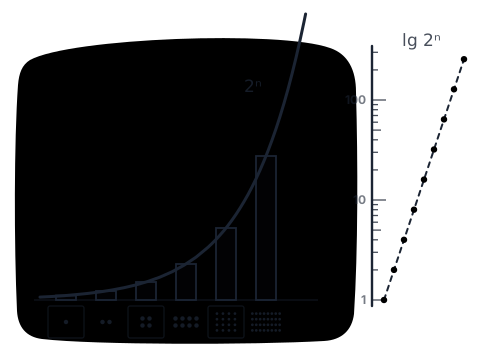
Letters, equations, functions — and numbers that “don’t exist”


Geometry
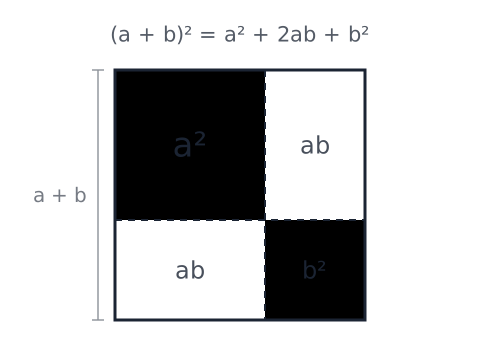
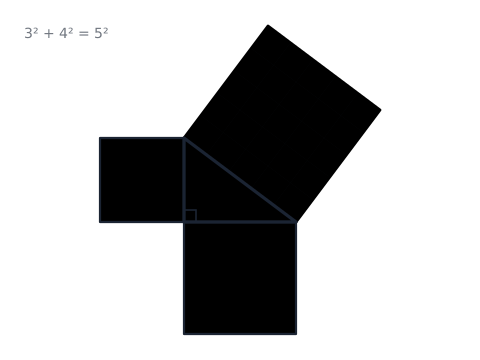
From Euclid’s axioms to the orbits of planets



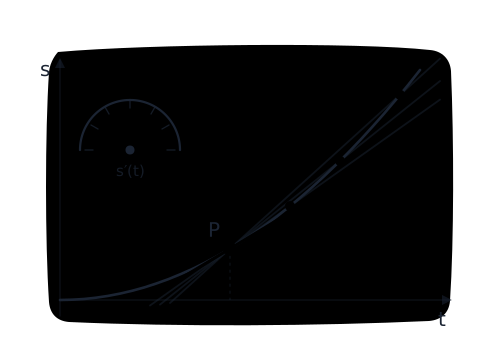
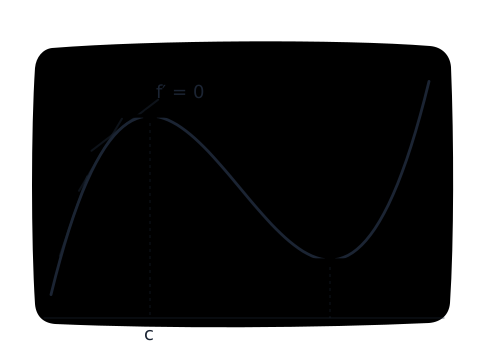
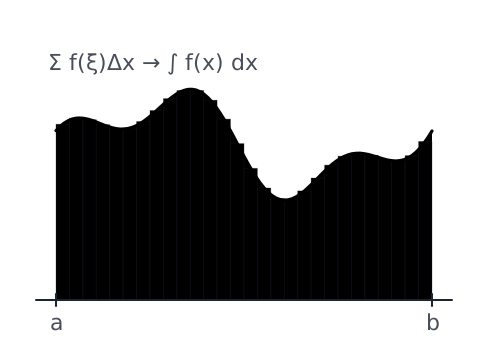
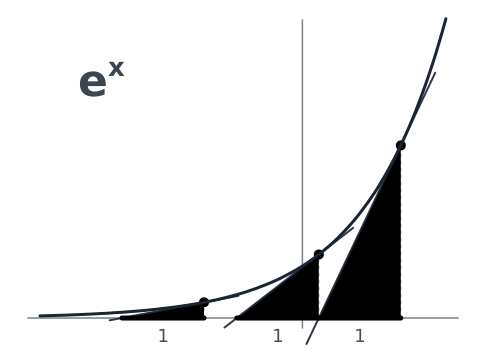
Calculus
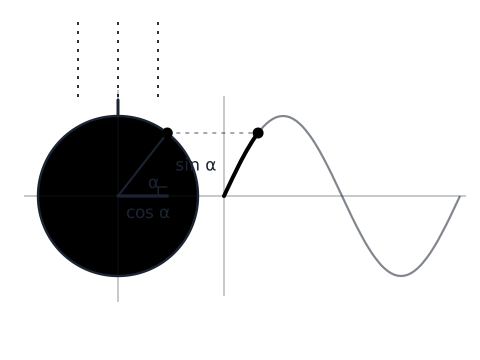
The infinitely small: speed, area, growth and waves
Linear algebra
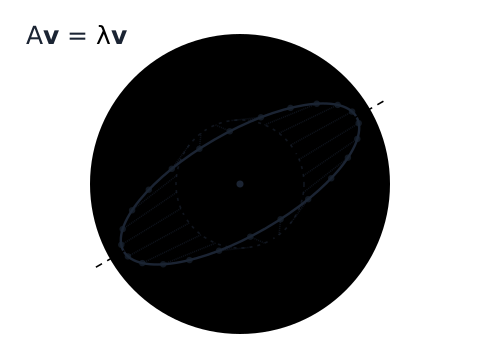
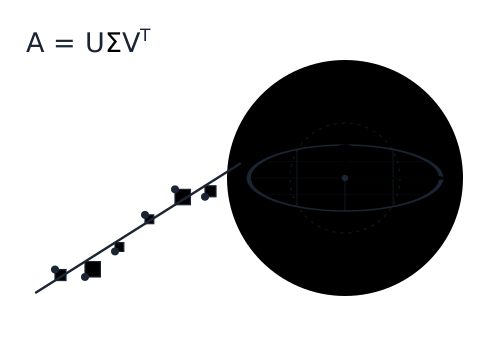
Matrices as transformations of space and data
Structures
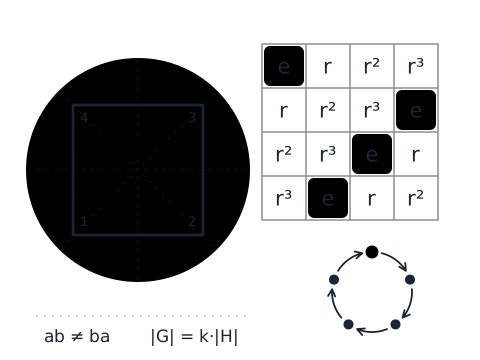
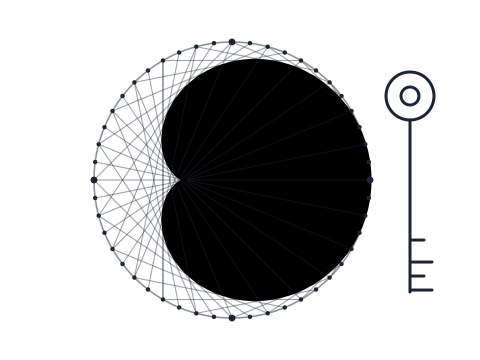
Groups, rings and fields — and the ciphers the internet runs on


Chance & data
Counting, probability, statistics and information


Foundations
Logic, infinities and the limits of proof
Horizons
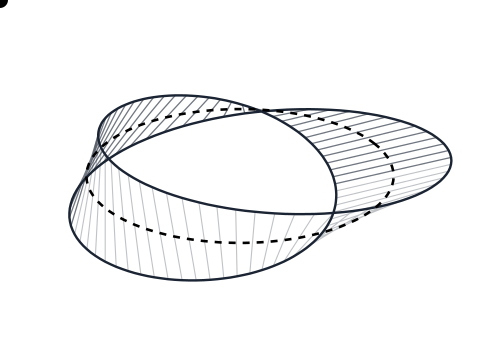
Topology, non-Euclidean worlds, chaos and open problems
Problem solvers
Type in your own problem — a solver works it out step by step and explains why each step is allowed.
- Quadratic equation
- Linear equation
- System of linear equations
- Higher-degree equations and factoring
- Inequalities by the interval method
- Derivative
- Integral
- Limit
- Curve sketching
- Fraction arithmetic
- GCD, LCM and Euclid's algorithm
- Prime factorization
- Solving a triangle
- Matrices: determinant, inverse, rank, eigenvalues
- Trigonometric equation
- Exponential and logarithmic equations
- Percentages, compound interest, loans
- Permutations and combinations
- Number bases
- Complex numbers
- Congruences
- Progressions
- Probability: Bayes and Bernoulli trials
- Differential equation
Also in the course
How the course works
A wall, then a ladder
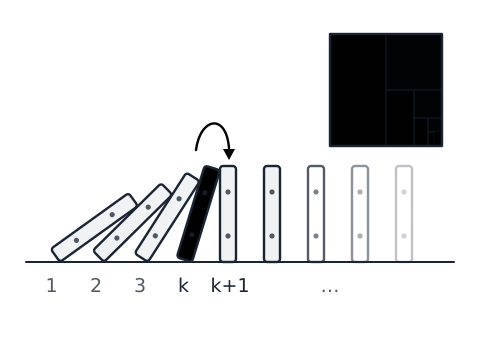
A chapter opens with a problem nothing so far can solve, and builds a tool for it. It ends at a new wall — where the next chapter begins.
Live diagrams
The widgets answer “what happens if…”. Drag, change, break things — nothing can be spoiled.
Formulas, piece by piece
Every important formula is taken apart: where each piece comes from, an example with numbers, and where the formula stops working.
Practice and solvers
Practice sets hand out problems for as long as you like. Solvers take your own problem and solve it step by step, with reasons.
Four levels
- Ages 11–15 School Arithmetic and curiosity are enough
- Ages 16–18 High school Builds on school algebra and geometry
- Years 1–2 University Like the first years at MIT, Cambridge or Moscow State
- Year 3 and up Beyond For readers who enjoy abstraction