Percentage calculator with working: percent of a number, change, savings, loans
A percentage of a number, a number from its percentage, the percentage change, chains of discounts and mark-ups, savings with compound interest and a loan repayment schedule, with every step explained.
15% of 240
x% of 240 = 36
from 80 to 100
+20% −20%
after a 20% discount the price is 800
deposit 100000 at 8% for 3 years compounded monthly
loan 1000000 at 12% for 5 years, annuity
loan 9930000 at 10% for 3 years, yearly payments
Loading the solver…
What you can type
The buttons above the field choose the type of problem, and each one opens a short phrase with blanks: “[15] % of [240]”, “from [80] to [100]”, “loan [1,000,000] at [12] % a year for [5] years”. The answer updates as you type. You can also write the same problem in words in the field below; the solver understands the usual phrasings from textbooks and everyday life: “what percent of 240 is 36”, “by what percent is 100 more than 80”, “after a 20% discount the price is 800”, “deposit 100000 at 8% for 3 years compounded monthly”, “loan 1 million at 12% for 5 years, differentiated”.
Thousands can be separated by commas or spaces (1,000,000) or written in words (“2.5 million”, “300k”), with a decimal point for fractions. For savings you give the amount, the rate, the term, how often interest is added to the balance, and a monthly top-up; for a loan, the amount, the rate, the term, the repayment scheme, and whether payments are monthly or yearly, as in the finance problems of school-leaving exams. The answer includes a repayment schedule you can copy into a spreadsheet.
A percent is a hundredth
The word comes from Latin: per centum, “per hundred”. Saying “$15\,\%$ of the pupils” is the same as saying “15 out of every hundred”. So a percentage is an ordinary fraction with denominator 100: $15\% = \frac{15}{100} = 0.15$. All percentage arithmetic rests on this equality.
The three school problems are one formula with one of the three letters unknown. To find a percentage of a number, multiply the number by the fraction. To find a number from its percentage, divide the part by the fraction. To find what percentage one number is of another, divide the part by the whole and multiply by $100\,\%$. If you’re not sure what to divide by what, ask yourself: what is $100\,\%$ here? That’s the whole.
Percentage change, and why percentages don’t add up
A price was 80 pounds and became 100. The difference is 20 pounds, but as a percentage it depends on what you compare it with. A change is measured from the old value: $\frac{20}{80} = 0.25$, so the price went up by $25\,\%$. If the price goes back from 100 to 80, it falls by $\frac{20}{100} = 20\%$: the same 20 pounds, but from a different base. Hence the confusion in the news: “up $25\,\%$, then down $20\,\%$”, and the price is back exactly where it was.
It’s easiest to think of a percentage change as a multiplication. Increasing by $15\,\%$ means keeping $100\,\%$ and adding another $15\,\%$, that is, multiplying by 1.15. Decreasing by $20\,\%$ means multiplying by 0.8. Then a chain of changes is a product of multipliers:
$$+20\%,\ -20\%:\qquad 1.2 \cdot 0.8 = 0.96.$$
After a $20\,\%$ rise and a $20\,\%$ fall, $96\,\%$ of the original is left: minus $4\,\%$, not zero. The second percentage is taken from the new, larger price. For the same reason, two $10\,\%$ rises give $1.1^2 = 1.21$, that is, $21\,\%$, not $20\,\%$.
The reverse problem, “after a $20\,\%$ discount an item costs 800; what did it cost before?”, is solved by dividing by the same multiplier: $800 \div 0.8 = 1000$. Adding the same $20\,\%$ back to 800 doesn’t work: you’d get 960, because $20\,\%$ of 800 is less than $20\,\%$ of 1000.
Compound interest and savings
A bank pays $8\,\%$ a year. If the interest is added to the balance every year, next year it earns interest itself. Each year the balance is multiplied by the same number, $1.08$, and over $n$ years by $1.08^n$. That’s where the power comes from, and with it the name “compound interest”. Without compounding, the addition is the same every year, $8\,\%$ of the starting amount, and growth is linear: that’s simple interest.
The more often interest is compounded, the bigger the result, but the difference soon stops growing. In 1683 Jacob Bernoulli asked what would happen if interest were added at every instant, and got a limit: the balance grows by a factor of $e^{rt}$, where $e \approx 2.718$. How the number $e$ came out of a banking problem is told in the chapter on the number $e$. For rough estimates there’s the “rule of 72”: at $r\,\%$ a year a deposit doubles in about $72 / r$ years. At $8\,\%$ that’s about 9 years; the exact answer is 9.006 years.
An annual rate with frequent compounding is deceptively modest: $8\,\%$ compounded monthly gives $\left(1 + \frac{0.08}{12}\right)^{12} - 1 \approx 8.3\%$ over a year. This actual return is called the effective annual rate (in the UK, the AER); the solver shows it next to the answer.
Loans: annuity and equal-principal repayments
Each month the debt first grows by the interest and then shrinks by your payment. Banks repay loans in two ways.
Annuity repayments: all payments are the same. At the start of the term the debt is large, and almost the whole payment goes on interest; towards the end the interest melts away, and the payment mostly pays off the debt. The size of the payment comes from the condition that after the last payment the debt is zero.
Where the formula comes from. After the first month the debt is $P(1+i) - A$, after the second $P(1+i)^2 - A(1+i) - A$, and so on. After $n$ months the original amount has grown by a factor of $(1+i)^n$, and the payments add up to the geometric series $A\,\frac{(1+i)^n - 1}{i}$. Set the difference to zero and solve for $A$.
Equal-principal repayments (also called “differentiated”) are simpler: the debt is paid off in equal parts $\frac{P}{n}$, and interest on the remaining debt is added to each part. The first payment is the largest, and each one after it is smaller than the one before by the same amount $\frac{P}{n}\,i$. The interest forms an arithmetic progression, and the total interest is $P\,i\,\frac{n+1}{2}$. On the same loan of a million it comes to $1{,}000{,}000 \cdot 0.01 \cdot \frac{61}{2} = 305{,}000$, thirty thousand less than with an annuity: the debt shrinks faster, and interest is charged on smaller amounts. The price is a heavier start: the first payment is 26,666.67 instead of 22,244.45.
Banks usually charge interest by the day rather than as “rate/12”, and round by their own rules, so their schedule may differ from this calculation by pennies or pounds. School and exam problems are calculated exactly as here.
Worked examples
Example 1. A price went up by $10\,\%$ and then down by $10\,\%$. How did it change?
Each change is a multiplication: $1.1 \cdot 0.9 = 0.99$. $99\,\%$ of the original price is left, so the price fell by $1\,\%$. If the price was 1000 pounds, after the rise it became 1100, and $10\,\%$ of 1100 is already 110 pounds, so after the fall it’s 990.
Example 2. After a $20\,\%$ discount a jacket costs 80 pounds. What did it cost before the discount?
A $20\,\%$ discount is multiplication by 0.8: $x \cdot 0.8 = 80$, so $x = 80 \div 0.8 = 100$. Check: $20\,\%$ of 100 is 20, and $100 - 20 = 80$. The answer 96, which you get by adding twenty percent of 80 to 80, is wrong.
Example 3. Savings of 100,000 at $8\,\%$ a year for 3 years, compounded monthly
Each month earns $\frac{8\%}{12} \approx 0.667\%$; the monthly multiplier is $q = 1 + \frac{0.08}{12}$, and there are 36 months:
$$S = 100{,}000 \cdot q^{36} \approx 127{,}023.71.$$
The interest earned is 27,023.71. Simple interest would give $100{,}000 \cdot (1 + 0.08 \cdot 3) = 124{,}000$: compounding brought in about three thousand more.
Example 4. An exam problem: a loan of 9,930,000 at $10\,\%$ a year, repaid in three equal annual payments
Once a year the debt is multiplied by $q = 1.1$, and then a payment $x$ is made. After three payments the debt must be zero:
$$\bigl((9{,}930{,}000 \cdot 1.1 - x) \cdot 1.1 - x\bigr) \cdot 1.1 - x = 0.$$
Expanding the brackets: $9{,}930{,}000 \cdot 1.331 = x\,(1.21 + 1.1 + 1) = 3.31\,x$, so $x = \frac{9{,}930{,}000 \cdot 1.331}{3.31} = 3000 \cdot 1331 = 3{,}993{,}000$. In total the bank receives 11,979,000, and the interest comes to 2,049,000.
Common mistakes
- Taking the percentage of the wrong number. “By what percent is 100 more than 80” is $\frac{20}{80} = 25\%$: we compare with 80. But “by what percent is 80 less than 100” is $\frac{20}{100} = 20\%$.
- Adding up the percentages in a chain. $+20\%$ and $-20\%$ give $-4\%$, not zero; two $10\,\%$ rises give $21\,\%$, not $20\,\%$.
- Adding a discount back. To find the price before a discount, divide by the multiplier; don’t add the same percentage to the new price.
- Confusing percent and percentage points. A rate rising from $8\,\%$ to $10\,\%$ is a rise of 2 percentage points, but of $25\,\%$.
- Dividing the annual rate by the wrong thing. With monthly payments, each month’s interest is the annual rate divided by 12, and the number of periods is the term in months. You can’t mix years and months in one formula.
- Rounding in the middle of a calculation. $1.01^{60}$ rounded to 1.8 gives a payment of 22,500 instead of 22,244: an error of over two hundred every month. Round only the answer.
- Comparing loans by a single payment. An annuity has a smaller payment at the start, but more interest overall. The fair comparison is the total of all payments; the solver shows both schemes side by side.
See also
Fractions, common denominators, and why a percent is just a hundredth are covered in the chapter on fractions. How frequent compounding leads to the number $e$ and the exponential is in the chapter “The number e and the exponential”. If you want to know how many years it takes a deposit to double, that’s the equation $1.08^t = 2$, which the exponential and logarithmic equation solver will solve. Arithmetic with ordinary fractions, step by step, is in the fraction solver.
Where this is explained
 5
Fractions
How to share seven pies fairly among three people, why you flip the fraction when you divide, and where the endless merry-go-round of the digits 142857 in one seventh comes from.
 29
The number e and the exponential
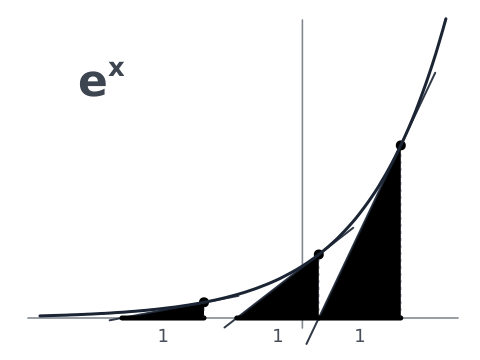
The same number, 2.71828…, has been spotted in a bank, on a graph, under a hyperbola, in radioactive decay, on a circle, in a cloakroom and at a bride’s choosing of a husband. Let’s log every sighting, like a naturalist in a field diary, and find out whether it’s one number or several look-alikes.
Other solvers
- Quadratic equation
- Linear equation
- System of linear equations
- Higher-degree equations and factoring
- Inequalities by the interval method
- Derivative
- Integral
- Limit
- Curve sketching
- Fraction arithmetic
- GCD, LCM and Euclid's algorithm
- Prime factorisation
- Solving a triangle
- Matrices: determinant, inverse, rank, eigenvalues
- Trigonometric equation
- Exponential and logarithmic equations
- Permutations and combinations
- Number bases
- Complex numbers
- Congruences
- Progressions
- Probability: Bayes and Bernoulli trials
- Differential equation