Limit calculator with step-by-step working and a table of values
Type the limit of a function or a sequence, and the solver identifies the indeterminate form, picks a technique (cancelling, the conjugate, equivalents, standard limits, L’Hôpital’s rule), explains every step and compares the answer with a table of values.
lim x->0 sin(x)/x
lim x->1 (x^2 - 1)/(x - 1)
lim x->∞ (1 + 1/x)^x
lim x->0 (1 - cos x)/x^2
lim x->∞ (sqrt(x^2 + x) - x)
lim x->∞ (3x^2 + 1)/(2x^2 - x)
lim x->0 1/x
lim x->0+ x ln x
Loading the solver…
What you can type
Write a limit with the word lim and an arrow: lim x->0 sin(x)/x. Type the arrow as -> or →, and infinity as ∞ or inf, with or without a sign: x -> -∞. Words work too: “limit of (x^2 - 1)/(x - 1) as x -> 1”, “sin x / x as x tends to 0”, and for a sequence, “(1 + 1/n)^n, n -> ∞”. LaTeX is understood as well: \lim_{x \to 0}.
A one-sided limit is marked with a sign after the point: x -> 0+ (from the right), x -> 0- (from the left); the alternative notation x -> +0, x -> 2 - 0 works, and so do the words “from the right” and “from the left”. If the function is defined on only one side of the point, as $\sqrt{x}$ or $x \ln x$ are near zero, the solver takes the limit from that side itself and says so.
How to evaluate a limit
1. Substitute the point. If the function is defined and continuous there, the limit equals its value: $\lim_{x \to 3} x^2 = 9$. Most “warm-up limits” end right here.
2. If substituting gives nonsense, identify what kind. $\frac{0}{0}$, $\frac{\infty}{\infty}$, $\infty - \infty$, $0 \cdot \infty$, $1^\infty$, $0^0$, $\infty^0$ are indeterminate forms: the answer could turn out to be anything, and it has to be extracted by rewriting. But $\frac{1}{0}$ isn’t indeterminate: the limit is infinite (or doesn’t exist, if the signs on the left and right differ).
3. Apply the technique that removes that particular form.
- $\frac00$ with polynomials: factorise the numerator and denominator and cancel the common factor $(x - a)$.
- $\frac00$ or $\infty - \infty$ with roots: multiply by the conjugate, $(\sqrt{A} - B)(\sqrt{A} + B) = A - B^2$.
- $\frac\infty\infty$ as $x \to \infty$: divide the numerator and denominator by the highest power of $x$.
- $\frac00$ with sines, exponentials and logarithms: replace factors with equivalent ones (table below) or use the standard limits.
- $1^\infty$: the limit that defines $e$, $\lim (1 + u)^{1/u} = e$, so $\lim\, (1 + u)^{v} = e^{\lim u v}$ when $u \to 0$.
- If nothing helps, L’Hôpital’s rule: the limit of a ratio of two infinitesimals (or two infinitely large quantities) equals the limit of the ratio of their derivatives, if the latter exists.
| As $u \to 0$ | Equivalent |
|---|---|
| $\sin u,\ \tan u,\ \arcsin u,\ \arctan u$ | $u$ |
| $1 - \cos u$ | $\dfrac{u^2}{2}$ |
| $e^u - 1$ | $u$ |
| $a^u - 1$ | $u \ln a$ |
| $\ln(1 + u)$ | $u$ |
| $(1 + u)^k - 1$ | $k u$ |
You may replace only factors in a product or quotient with equivalents, never terms in a sum; more on this trap below.
What a limit is and why the techniques are legitimate
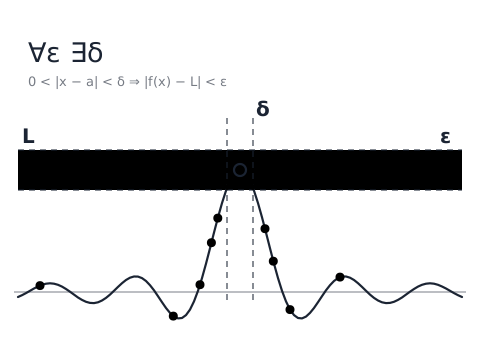
The words “$f(x)$ tends to $L$” mean that the values of the function are as close to $L$ as you like, provided $x$ is close enough to $a$. The point $a$ itself doesn’t come into it: the function may be undefined there, or equal to anything at all. Cauchy put this rigorously, and Weierstrass gave it the “epsilon–delta” form:
This is why cancelling is legitimate: for $x \ne a$ the fractions $\frac{(x - 1)(x + 1)}{x - 1}$ and $x + 1$ agree, and the limit looks only at $x \ne a$. Multiplying by the conjugate is legitimate in the same way: it doesn’t change the values of the function near the point.
The first standard limit, $\lim_{x \to 0} \frac{\sin x}{x} = 1$, is proved with areas (some textbooks call it the “first remarkable limit”). In the unit circle, for $0 < x < \frac\pi2$, a triangle, a sector and a bigger triangle give $\sin x < x < \tan x$. Dividing by $\sin x$ and taking reciprocals gives $\cos x < \frac{\sin x}{x} < 1$. As $x \to 0$, the cosine tends to one, and so does the fraction squeezed between them. All the equivalences in the table follow from this limit and from $\lim_{u \to 0}(1 + u)^{1/u} = e$.
Worked examples
Example 1. Cancelling: $\lim\limits_{x \to 1} \dfrac{x^2 - 1}{x - 1}$
Substitution gives $\frac00$. The numerator factorises: $x^2 - 1 = (x - 1)(x + 1)$. Cancel $x - 1$ (it isn’t zero while $x \ne 1$):
$$\lim_{x \to 1} \frac{(x - 1)(x + 1)}{x - 1} = \lim_{x \to 1} (x + 1) = 2.$$
The table agrees: $f(0.999) = 1.999$, $f(1.001) = 2.001$.
Example 2. The conjugate: $\lim\limits_{x \to +\infty} \left(\sqrt{x^2 + x} - x\right)$
The form is $\infty - \infty$. Multiply and divide by $\sqrt{x^2 + x} + x$:
$$\sqrt{x^2 + x} - x = \frac{(x^2 + x) - x^2}{\sqrt{x^2 + x} + x} = \frac{x}{\sqrt{x^2 + x} + x} = \frac{1}{\sqrt{1 + \frac1x} + 1} \to \frac{1}{1 + 1} = \frac12.$$
The answer is $\frac12$, even though both parts of the difference go off to infinity: at $x = 1000$ the difference is $0.49988$.
Example 3. The highest power: $\lim\limits_{x \to \infty} \dfrac{3x^2 + 1}{2x^2 - x}$
Divide the numerator and denominator by $x^2$: $\frac{3 + 1/x^2}{2 - 1/x} \to \frac{3}{2}$. A rule for the future: when the degrees are equal, the limit is the ratio of the leading coefficients; if the numerator’s degree is smaller, it’s zero; if larger, it’s infinite.
Example 4. The limit that defines $e$: $\lim\limits_{x \to \infty} \left(1 + \dfrac{2}{x}\right)^{3x}$
The form is $1^\infty$. Here $u = \frac2x \to 0$, the exponent is $v = 3x$, and $u \cdot v = 6$. So
$$\lim_{x \to \infty} \left(1 + \frac2x\right)^{3x} = \lim_{x \to \infty} \left(\left(1 + \frac2x\right)^{\frac{x}{2}}\right)^{6} = e^6.$$
Example 5. One-sided limits: $\lim\limits_{x \to 0} \dfrac1x$
To the right of zero the fraction is positive and grows without bound: $\lim_{x \to 0^+} \frac1x = +\infty$. To the left it is negative: $\lim_{x \to 0^-} \frac1x = -\infty$. The limits from the two sides differ, so there is no two-sided limit. Compare with $\frac{1}{x^2}$: there both sides give $+\infty$, and we write $\lim_{x \to 0} \frac{1}{x^2} = +\infty$.
Common mistakes
- “$\frac00 = 1$”, “$1^\infty = 1$”, “$\infty - \infty = 0$”. These aren’t numbers but signals that say “rewrite this”. $\frac{\sin x}{x} \to 1$, but $\frac{\sin 2x}{x} \to 2$, and $\frac{\sin x}{x^2}$ has no finite limit at all, yet all three have the same form.
- Equivalents in a sum. In $\frac{\tan x - \sin x}{x^3}$ you can’t replace $\tan x$ and $\sin x$ with $x$: you’d get $\frac{0}{x^3} = 0$, while the right answer is $\frac12$. First write $\tan x - \sin x = \tan x\,(1 - \cos x)$, and only then use equivalents for the factors: $x \cdot \frac{x^2}{2}$.
- L’Hôpital without an indeterminate form. $\lim_{x \to 0} \frac{\cos x}{x + 1} = 1$, while “by L’Hôpital” you’d get $\frac{-\sin 0}{1} = 0$. The rule works only for $\frac00$ and $\frac\infty\infty$.
- Confusing the limit with the value. The limit of $\frac{x^2 - 1}{x - 1}$ as $x \to 1$ is $2$, even though the fraction isn’t defined at the point itself.
- Forgetting about the sides. $\lim_{x \to 0} e^{1/x}$ doesn’t exist: from the left it’s $0$, from the right $+\infty$. The answer “infinity” is wrong.
- Losing the sign of a root as $x \to -\infty$. $\sqrt{x^2} = |x| = -x$ for negative $x$; so $\lim_{x \to -\infty} \frac{\sqrt{x^2 + 1}}{x} = -1$, not $1$.
See also
The definition of a limit as the game “you give me $\varepsilon$, I give you $\delta$”, the proof of the first standard limit and a gallery of discontinuities are in the chapter on limits: the rules of the game, the sine under a microscope, kinds of discontinuity. The number $e$ as the limit of $(1 + \frac1n)^n$ is in the chapter on the number e. Limits are used to define the derivative and the improper integral, and the asymptotes of a graph are found in curve sketching. For practice, try the limits trainer.
Where this is explained
Other solvers
- Quadratic equation
- Linear equation
- System of linear equations
- Higher-degree equations and factoring
- Inequalities by the interval method
- Derivative
- Integral
- Curve sketching
- Fraction arithmetic
- GCD, LCM and Euclid's algorithm
- Prime factorisation
- Solving a triangle
- Matrices: determinant, inverse, rank, eigenvalues
- Trigonometric equation
- Exponential and logarithmic equations
- Percentages, compound interest, loans
- Permutations and combinations
- Number bases
- Complex numbers
- Congruences
- Progressions
- Probability: Bayes and Bernoulli trials
- Differential equation