Mathematics
Calculus
Every chapter of the course by topic, level and part. You can pick several topics at once — say, “Puzzles” and “Probability”.
 0
What mathematics is
A rope round the Earth, a sunflower, a dragon made of a paper strip and an ant that suddenly starts building a highway. Five short stories about how mathematics surprises, why it needs proofs and which seven questions lie ahead.
 1
Counting: from notches to bits
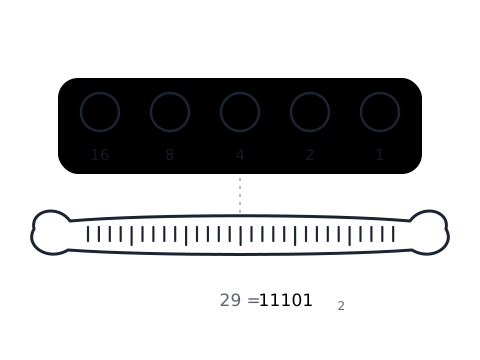
How do you write a number too big for your fingers or for notches on a stick? A walk through the halls of a museum of counting, from a notched bone to binary code, to see how people learned to pack any number into a few signs.
 2
Zero and minus
What is 3 − 5? A seventeenth-century sceptic is sure it’s nothing, and he calls “minus times minus” nonsense. Let’s argue with him by the rules: every sign rule will have to be defended.
 3
Prime numbers
Some numbers can’t be broken into factors. Everything else is built from them by multiplication, there are infinitely many of them, and nobody can say in advance where the next one will turn up.
 4
Divisibility and Euclid's algorithm
Puzzles about a calendar, a long number, tiles, jugs and coins, and one answer to all of them: the greatest common divisor, and a way to find it that is more than two thousand years old.
 5
Fractions
How to share seven pies fairly among three people, why you flip the fraction when you divide, and where the endless merry-go-round of the digits 142857 in one seventh comes from.
 6
Root two and the real numbers
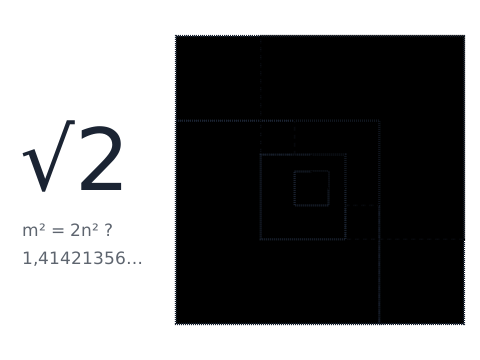
The case of the square’s diagonal: three independent expert reports prove that its length can’t be written as a fraction. We look at how the Babylonians lived with it, what continued fractions are, and where the real numbers come from.
 7
Letters for numbers
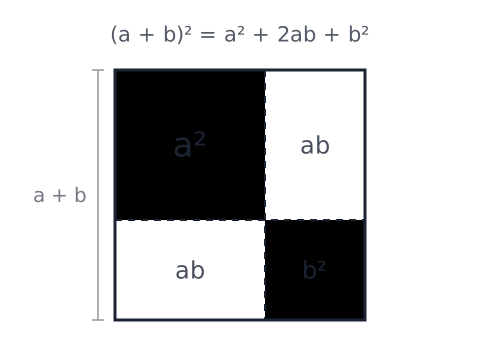
A magician guesses the number you thought of and does mental arithmetic faster than a calculator. We’ll expose his tricks one by one, and along the way learn to write down a rule that holds for all numbers at once.
 8
Equations: the art of balance
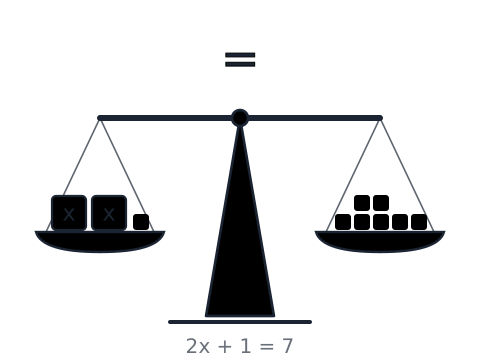
An equation is a pair of scales in balance with a box of unknown weight on it. We’ll learn to take things off the pans without making the scales tip, and find out where the word “algebra” itself comes from.
 9
Functions and graphs
Sometimes the answer to a question isn’t a number but a rule. Let’s play with machines that turn some numbers into others: learn to crack them from a few throws, see them whole in a single picture, tune them, chain them into a production line and run them in reverse.
 10
Quadratic equations
The problem the last chapter ended with is nearly four thousand years old. Let’s excavate it layer by layer, from a clay tablet to the quadratic formula, and see what the formula really says.
 11
Systems of equations and inequalities
When there are several conditions, one equation isn’t enough. Let’s open a small toy workshop: find prices from two invoices, work an ancient Chinese counting board, run into the limits of the storeroom and find out why the most profitable plan always sits in a corner.
 12
Powers and logarithms
A quantity that is multiplied at every step sooner or later outgrows any quantity that is added to, and usually sooner than you’d think. Let’s hold a race of growth rates, then find a tool that turns multiplication into addition and tames astronomical numbers.
 13
Sequences and induction
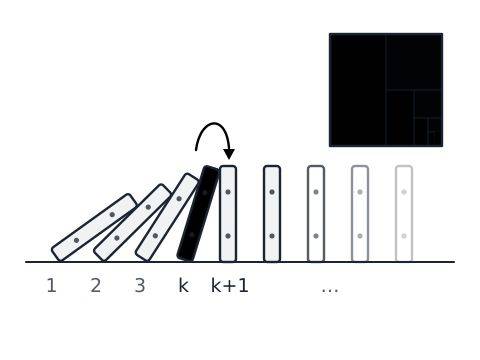
How to add a hundred numbers in a minute, why an infinite sum can be finite, and how to prove a statement for every n at once: by standing dominoes in a row and pushing the first one.
 14
Polynomials
In 1535, in Venice, two mathematicians exchanged thirty problems, and every problem set by one of them was a cubic equation. Let’s follow that duel to the end, and along the way gather the weapons used ever since to solve equations of high degree.
 15
Complex numbers
For almost three hundred years a number whose square is −1 was thought impossible. Let’s follow how it turned from a trick into a symbol, from a symbol into a point, and from a point into a rotation, and what happened to equations after that.
 16
The Elements: axioms and constructions
Around 300 BC a book was written in Alexandria that teaches you to tell ‘looks right in the drawing’ from ‘always true’. Its rules are compass and straightedge, and you can play by them.
 17
The triangle
A laboratory with a single instrument: a movable triangle. We drag the vertices, notice what doesn’t change, and prove why, from the congruence tests to the Euler line.
 18
Pythagoras' theorem
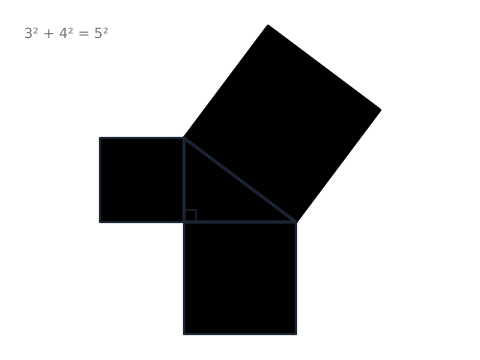
The most famous theorem in geometry and its gallery: five halls, each with its own proof: Chinese, Euclid’s, by similarity, a president’s, and a puzzle without formulas. On the way out: whole-number triples, distances and Fermat’s riddle.
 19
The circle and the number π
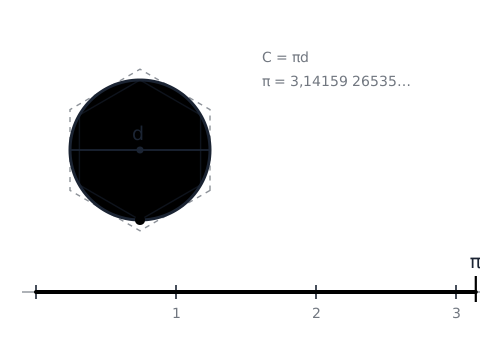
A four-thousand-year chase after one number, from a rope round a barrel to supercomputers. Along the way, the theorems of the circle: the angle in a semicircle, the inscribed angle, the tangent, crossing chords and the area of a disc. And to finish, the trap of the chords: 1, 2, 4, 8, 16, and then 31.
 20
Area and volume
A workshop with scissors: we cut figures, rearrange the pieces and find out what area is. Any polygon can be re-cut into any other of the same area, but a disc and a cube won’t give in to scissors.
 21
Trigonometry
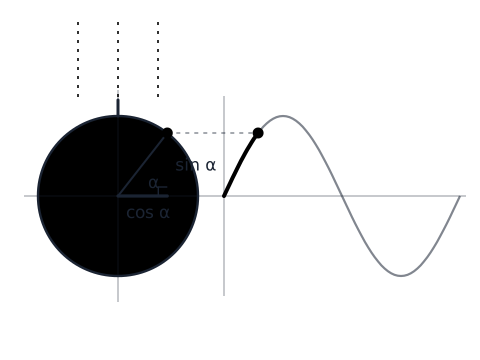
A surveying expedition: from a pole’s shadow to the width of a river, the height of a mountain and the size of the whole Earth. Along the way angles turn into numbers (sine, cosine, tangent) and the circle unwinds into a wave.
 22
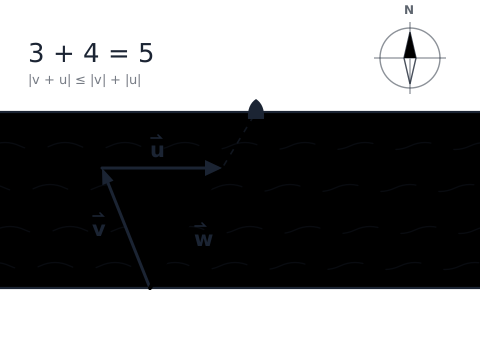
Vectors and coordinates
The engine pulls the boat one way, the current another, the wind blows a third. The navigator adds all this up as arrows, and calculates with arrows as confidently as with numbers.
 23
Symmetry and transformations
An ornament workshop: we draw a motif, and mirrors, rotations and shifts turn it into a rosette, a frieze and a wallpaper. Along the way it turns out that there are only four ways to move the plane without distortion, and seventeen ways to repeat a pattern over the whole plane.
 24
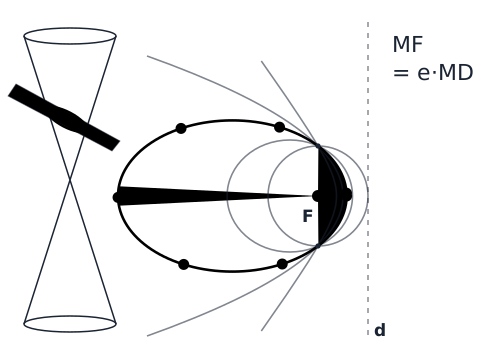
Conic sections
Cut a cone with a plane and you get the curves along which planets, comets and interstellar visitors fly. One night at the observatory: from Apollonius’ drawings to satellite dishes and the Earth’s orbit.
 25
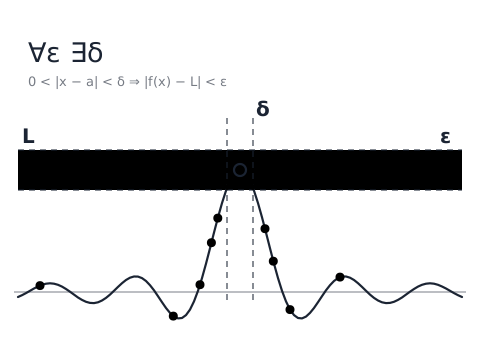
Limits
Speed at an instant looks like zero divided by zero. For a century and a half mathematicians used it without being able to explain what it was. The explanation turned out to be a game against a stubborn opponent: let’s learn its rules.
 26
The derivative
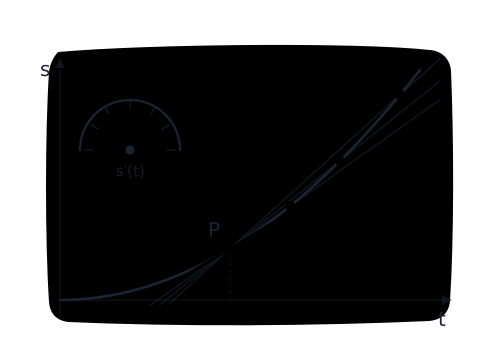
What does a speedometer really show? Let’s get into a car with a dashcam, turn average speed into instantaneous speed, and learn to find the slope of any smooth graph at any of its points.
 27
Extrema and optimization
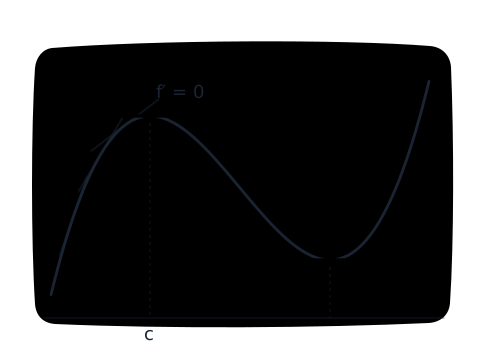
An inventors’ contest: a box from a sheet, a speed camera on a highway, a lifeguard on a beach, a tin can and the square root of two on a calculator with no square-root key. Each task has infinitely many options, and the derivative finds the best.
 28
The integral
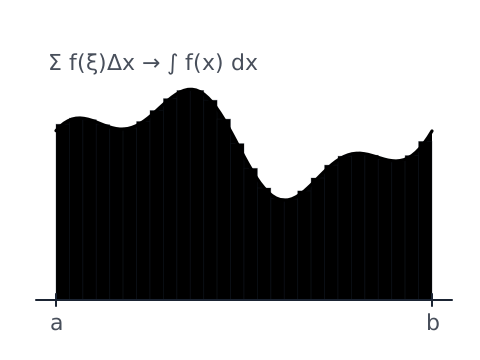
The biography of one idea: cut a figure into thin strips and add them up. It was born in Syracuse, grew up in the age of indivisibles, met the tangent in the hands of Newton and Leibniz, and got a rigorous definition from Riemann.
 29
The number e and the exponential
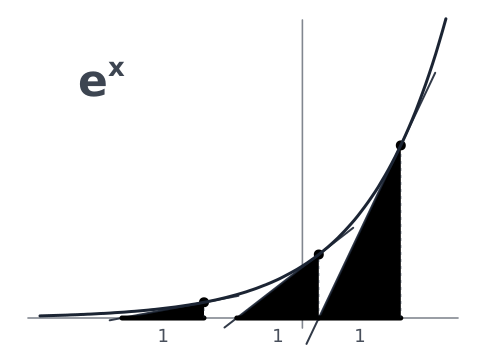
The same number, 2.71828…, has been spotted in a bank, on a graph, under a hyperbola, in radioactive decay, on a circle, in a cloakroom and at a bride’s choosing of a husband. Let’s log every sighting, like a naturalist in a field diary, and find out whether it’s one number or several look-alikes.
 30
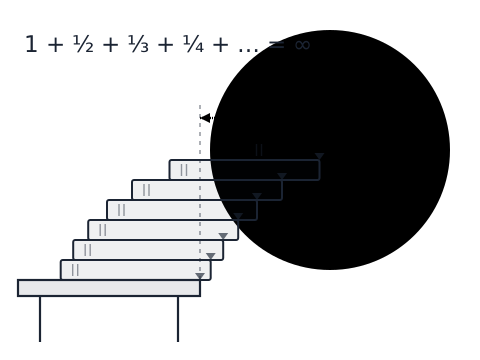
Series
An infinite sum can be added up, but it has to be handled with care: one converges, another runs off to infinity, a third changes its answer if you rearrange the terms. Let’s walk through a cabinet of curiosities of infinite sums, from a stack of books over an abyss to a polynomial that passes itself off as the sine.
 31
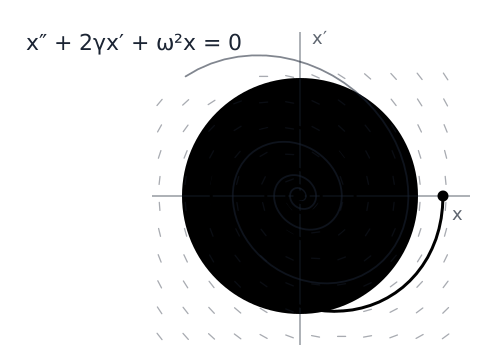
Differential equations
The laws of nature rarely say how much of something there will be; they say how fast it changes. Welcome to a lab where processes are grown from such laws: cooling coffee, a spring, wolves and hares, an epidemic. And we’ll find out why a uniquely determined future isn’t the same as a predictable one.
 32
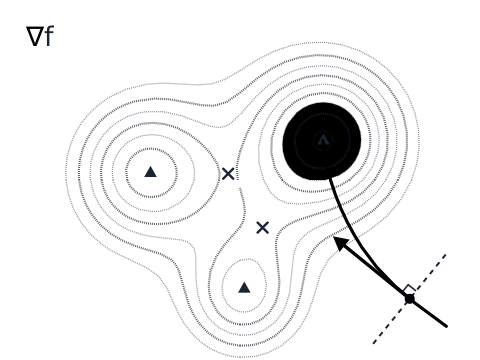
Functions of several variables
The height on a mountainside depends on two coordinates at once. Let’s take a map, a magnifier and a compass and find out which way such a function grows fastest, where its peaks and passes are, and why the area under the Gaussian bell is the square root of π.
 33
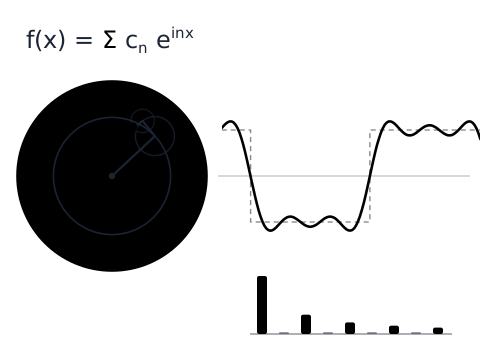
Fourier series
The sound of a violin, the temperature in a ring and an outline drawn with a finger can all be taken apart into sine waves and put back together. We’ll find out how to get a curve’s harmonics, why a step always keeps a ringing, and how the same trick compresses photos and music.
 34
Complex analysis
A function of a complex variable can’t be drawn as a graph, but it can be hung on the wall as a painting. Let’s walk round an exhibition of such paintings and find out why the series for 1/(1 + x²) converges only for |x| < 1, and why every polynomial has a root.
 35
Matrices as transformations
Four numbers in two columns can rotate the plane, stretch it, skew it, reflect it in a mirror or squash it flat onto a line. Let’s learn to read a matrix as the blueprint of a deformation: chain deformations together, undo them, and tell from a single number how much area changes.
 36
Gaussian elimination
How to find a lost planet from a few observations: turn a system of many equations into a staircase and read the answer from the bottom up. The steps show at once whether the system has one solution, infinitely many or none.
 37
Vector spaces
Arrows, polynomials, sound signals and even magic squares are added and multiplied by numbers by the same rules. Eight axioms, and everything we know about arrows starts working in all these worlds at once.
 38
Eigenvectors
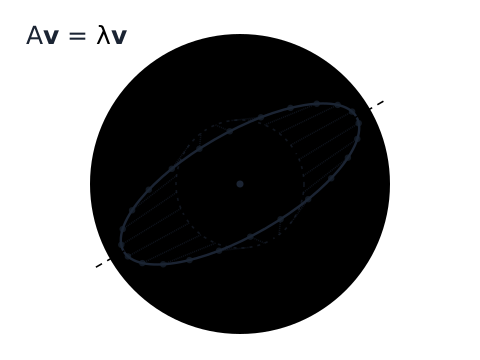
A matrix usually turns vectors, but many matrices have directions they only stretch. Let’s find them, and it will turn out that the Fibonacci numbers, the Google search engine and a tilted ellipse all work the same way.
 39
Orthogonality, least squares and SVD
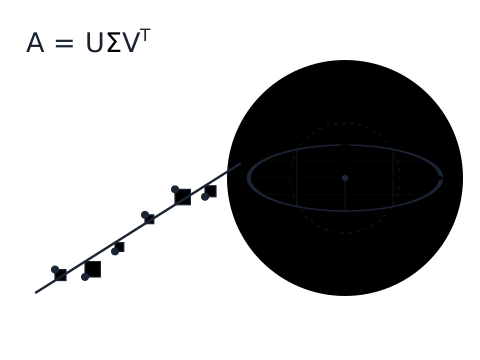
A data lab: the measurements won’t lie on a line, a cloud of points is stretched on a slant, a photograph takes up too much space. One idea copes with all three problems: drop a perpendicular.
 40
Groups
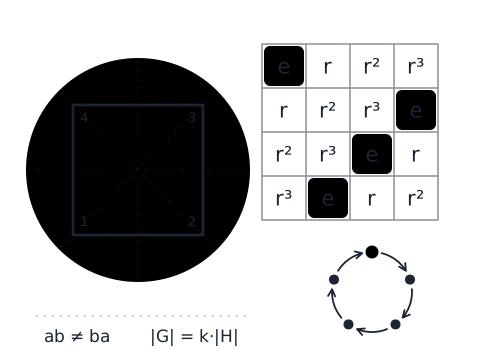
A cardboard square, a deck of cards, the fifteen puzzle and the Rubik’s cube: four puzzles behind which stands a single structure of four rules. Let’s assemble it and find out why 14 and 15 can’t be swapped in the fifteen puzzle, and how many times R U has to be repeated for the cube to come back solved.
 41
Modular arithmetic and ciphers
How do you agree on a secret when everyone can hear your conversation? A cipher-maker’s workshop: Caesar’s wheel, key exchange, RSA, and the arithmetic of remainders on which each of these locks rests.
 42
Rings, fields and codes
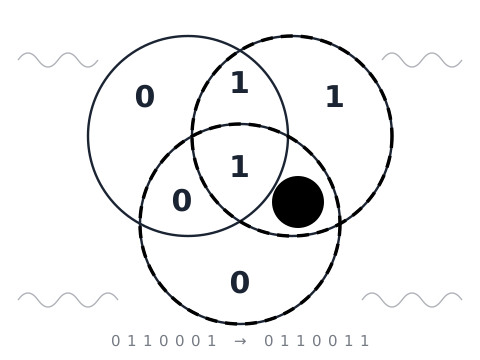
How do you correct an error in a message when you can’t ask for it again? An engineer’s logbook: from triple repetition and Hamming’s three circles to Galois fields and the Reed–Solomon codes hidden in every QR code.
 43
Galois theory
Why there’s no formula for the quintic, why an angle can’t be trisected with compass and straightedge, and why a regular seventeen-sided polygon can be constructed. All three questions are answered by one idea: the symmetries of the roots. Its author, Évariste Galois, died at twenty.
 44
The zeta function and elliptic curves
How accurate is Gauss’s formula for the number of primes? The answer is hidden in the zeros of one function of a complex variable, and where all those zeros lie nobody knows. Next door are cubic curves whose points add up like numbers: they proved Fermat’s Last Theorem and they guard your bank.
 45
Combinatorics
A board-game evening: dice, cards, counters, hats and guests. We’ll learn to count possibilities without listing them, and see that in a large enough crowd some order appears all by itself.
 46
Graphs
A walk round town: bridges, crossroads, roads and maps. Euler reduced a city to nothing but points and the lines between them, and solved the bridge problem. The same trick is used today to plan routes, draw up timetables and colour maps.
 47
Probability
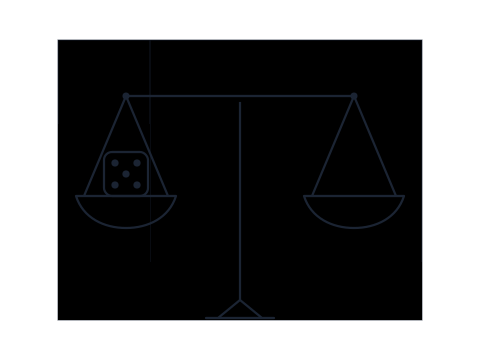
Intuition on trial: seven cases of faulty reasoning about chances, at the gaming table, in a TV studio, in a doctor’s surgery and in a courtroom. We’ll learn to compute probabilities and to recognise the traps that caught gamblers, professors and juries.
 48
Random variables
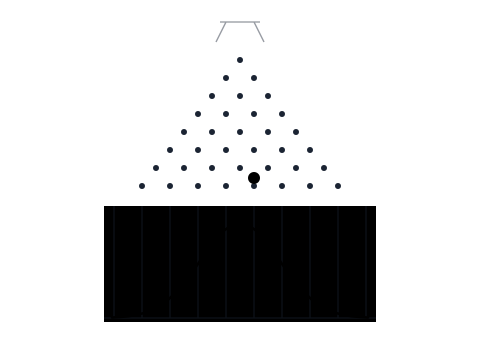
A laboratory of chance: we throw dice and needles, drop balls onto pegs, count kicks from horses. Each law is first observed in an experiment and then proved, and we see why the average of many random numbers is hardly random at all.
 49
Statistics
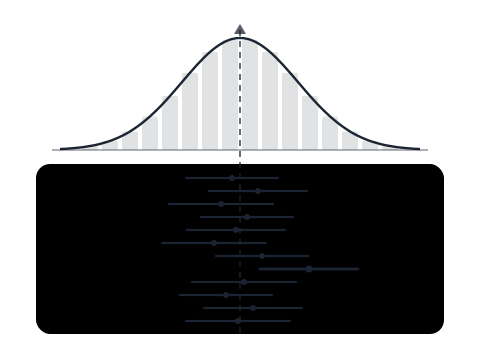
Five newspaper headlines, five investigations. An average salary, a poll with a three per cent margin of error, a ‘proven’ drug, chocolate and Nobel prizes, university admissions: we learn to judge the whole from a sample without fooling ourselves.
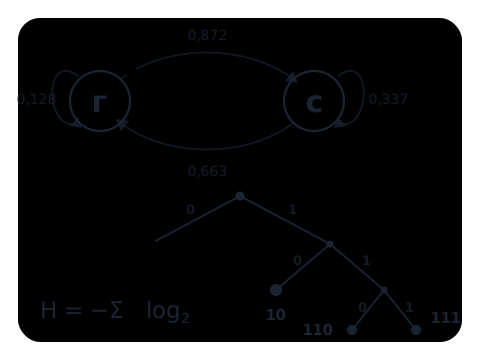 50
Markov chains and information
The letters of a text depend on the ones before them, the weather on yesterday’s. We’ll count this dependence as Markov did in Eugene Onegin, and measure how much information a letter carries, as Shannon did.
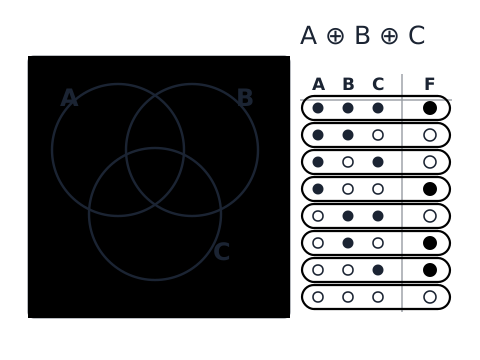 51
Logic and sets
For fifty chapters we’ve said ‘for every’, ‘there exists’, ‘therefore’ and ‘set’ without looking at the grammar. We’ll learn it on an island where some inhabitants always tell the truth and others always lie.
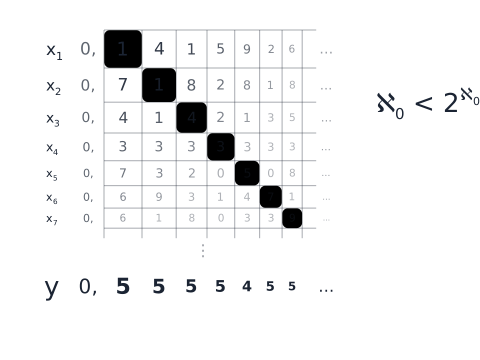 52
Infinities
Galileo’s three characters argue about which is larger: the natural numbers or the points of a segment. On the way they meet a hotel that always has a free room, Cantor’s diagonal and a tower of infinities with no top floor.
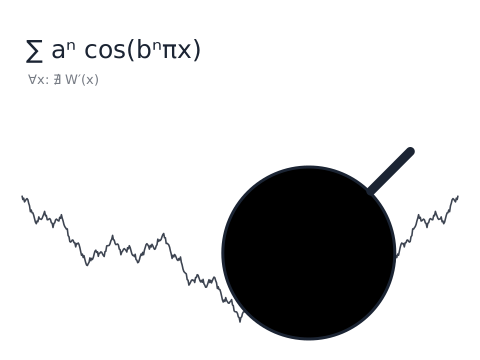 53
Rigorous analysis
A continuous function without a single tangent, a function that can’t be drawn, a limit of continuous functions with a jump. A bestiary of the monsters that made analysis rigorous, and the tools that tamed them.
 54
Measure and the Lebesgue integral
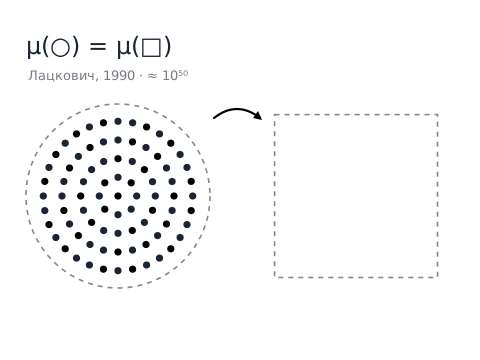
How much do all the fractions in a segment weigh? The answer ‘nothing’ forced length to be defined afresh, and led to an integral that can handle the Dirichlet function, to sets that can’t be measured, to a ball from which two are assembled, and to a circle cut into a square.
 55
Functional analysis
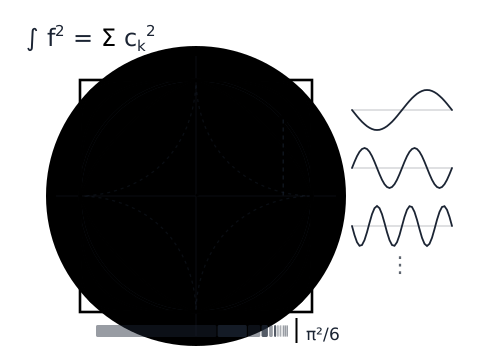
A function is a point of a space with infinitely many dimensions. It has lengths, angles and projections, Pythagoras’ theorem with infinitely many legs gives π²/6 once again, and the fixed point of a contraction draws a fern. But some familiar things break at this border.
 56
Gödel, Turing and the limits of proof
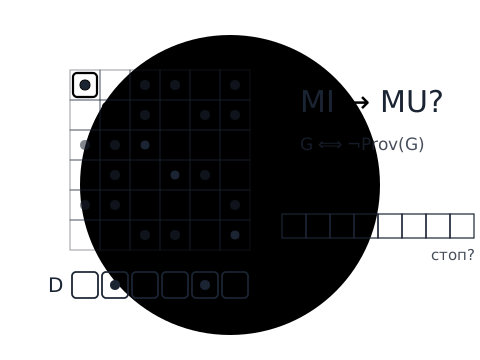
A puzzle with four rules, a number that talks about itself, and a program that can’t be written. In 1931 Gödel proved that arithmetic has true but unprovable statements, and in 1936 Turing proved that some questions can’t be settled by any algorithm.
 57
Topology
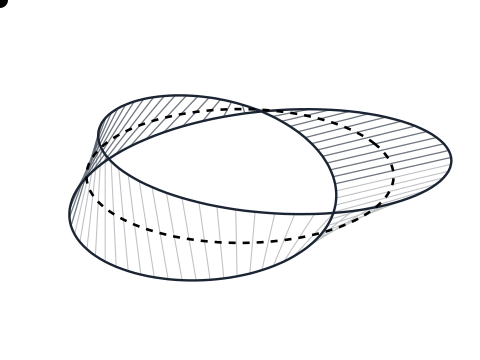
Geometry in which shapes can be kneaded. Here a mug can’t be told from a doughnut, a strip of paper can have one side, a knot provably can’t be untied, and at any moment there’s a place on Earth where no wind blows.
 58
Non-Euclidean geometries
A travel diary through three worlds. In the plane the angles of a triangle add up to exactly 180°, on a sphere to more, and in Lobachevsky’s world to less, and there infinitely many parallels pass through a point.
 59
Chaos and fractals
A one-line formula, Lorenz’s three equations, a game of dice, and behaviour that no computer can predict. A lab notebook of nine experiments: why the weather can’t be forecast a month ahead, and where a coastline gets a fractional dimension.
 60
The frontier
The course ends where the answers end. A map of the unknown: the Millennium Problems, the Collatz conjecture, P versus NP; how mathematics is done today, together, with computers, Lean and AI; and a return to the seven questions we started with.
Nothing found. Try removing one of the filters.