Clouds, a mountain skyline, veins in marble, curls of smoke look random but not chaotic: big shapes carry smaller details, and those carry smaller ones still. Computer graphics learned to fake this kind of nature with fractal noise. It shapes game worlds from Minecraft’s mountains to whole planets, and the stone, fire and water of film effects.
How it works
It starts with lattice noise: each grid node holds a random number or a random direction (a gradient), and values in between are smoothly interpolated into gentle hills about one cell across. “Basis” picks the recipe: simplex uses a triangular grid and shows no axes, Perlin a square grid of gradients, value plain random numbers at the nodes (a slightly blocky look), and cellular the distance to the nearest random point.
The fractal look comes from adding octaves, each twice as fine as the last, its amplitude multiplied by “Gain”. “Sum” decides what happens to an octave before it is added: fbm takes it as it is; “ridged” squares one minus its absolute value, turning zero crossings into sharp crests, and weights each octave by the previous one so small ridges grow on big ones; “billow” and “turbulence” take the absolute value for puffy lumps and creases.
Since the frequency exactly doubles, the period survives and the picture tiles seamlessly. In animation the gradients rotate a whole number of turns per loop, so the last frame meets the first.
A bit of history
Ken Perlin invented his noise in the early 1980s, after working on Tron (1982), tired of the machine-made look of computer graphics. His paper “An Image Synthesizer” appeared in 1985, with marble and turbulence already in it, and in 1997 Perlin noise earned him an Academy Award for Technical Achievement. In 2001 he followed up with simplex noise, faster and free of grid artefacts. This layer uses psrdnoise, a periodic simplex noise with rotating gradients published by Stefan Gustavson and Ian McEwan in 2022. The ridged mode goes back to F. Kenton Musgrave’s ridged multifractals in Texturing and Modeling (1994).
What to tweak
- Set “Sum” to “ridged”, “Octaves” to 7–8 and “Gain” near 0.5 for a map of mountain ranges.
- “Turbulence” with “Warp” at 0.6–1 looks like flames or marble swirls.
- “Terraces” at 6–12 turn clouds into stepped plateaus, like a relief map.
- “Alpha from brightness” keeps only the light parts, so clouds can drift over another layer.
- Put the “Wallpaper symmetry” effect on top with the p6m group and the noise becomes an endless snowflake ornament (the “Noise kaleidoscope” stack).
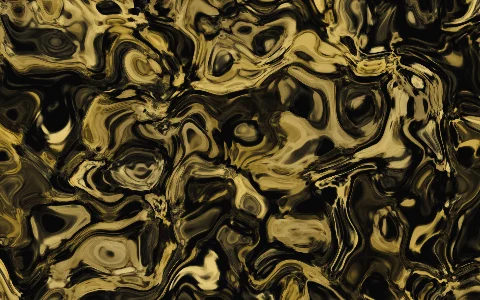 Domain warping
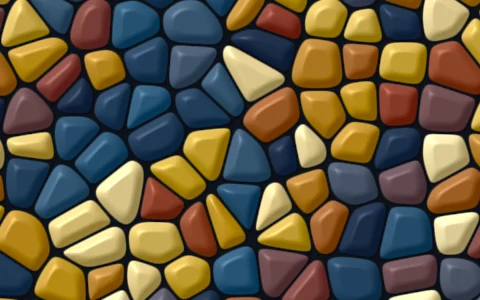 Cellular noise
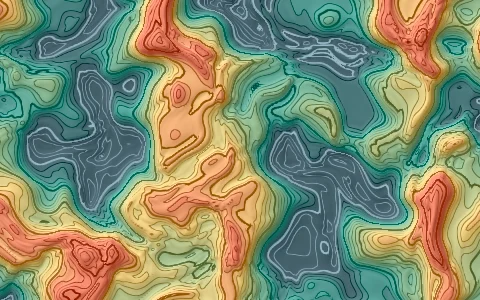 Topographic map
 Mesh gradient
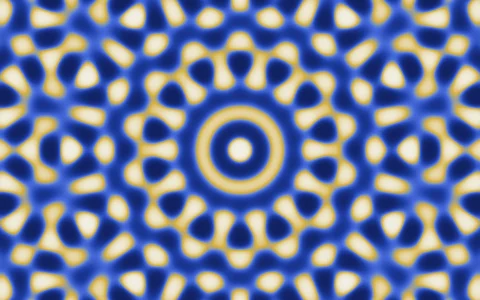 Quasicrystal
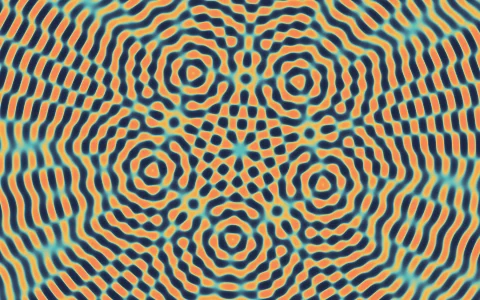 Wave interference
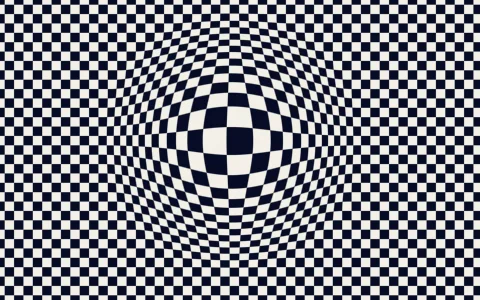 Op art