When two stones drop into a pond, their rings cross and a still fan appears on the water, bands of ripples separated by bands of calm. This is interference: crest meeting crest grows, crest meeting trough cancels. Sound, light and radio obey the same rule, and interference is at the heart of holograms, radio telescopes, precision interferometers and phased-array antennas, from radar to satellite-internet dishes.
How it works
“Sources” places 1 to 12 points on the canvas; “Arrangement” sets them in a ring, a row, a grid or at random (random sources also get random starting phases). Each sends out a circular wave; the generator sums them at every point.
λ is the “Wavelength”, as a fraction of the short side. Amplitude falls off as 1/√r, as a circular wave’s energy spreads along an ever longer ring; “Decay” adds absorption, so distant sources stop interfering. To keep the contrast even, the sum is normalised by the wave energy at each point. With two sources the lines of calm are hyperbolas with the sources at their foci, the textbook picture. “Smooth” and “bands” show the height of the water, while “rings — moiré” draws only each source’s crests as thin circles; where they drift in and out of step, the eye sees moiré, broad ghostly bands. In animation the crests travel a whole number of wavelengths per loop, so the loop closes.
A bit of history
Between 1801 and 1803 Thomas Young ran his famous interference experiment: two close beams of light make alternating bright and dark bands on a screen, the strongest case yet for light as a wave rather than Newton’s particles. Young also drew two sets of circular water waves in his Course of Lectures on Natural Philosophy (1807), a picture that has travelled through textbooks ever since. The ripple tank, a shallow tray of water lit from below with vibrating dippers, became a standard classroom instrument. And “moiré” is named after a French silk with shimmering watered patterns, made by pressing two layers of fabric together.
What to tweak
- Two sources in a “row” with “Decay” at 0 give Young’s classic picture; shorten the “Wavelength” for more hyperbolas.
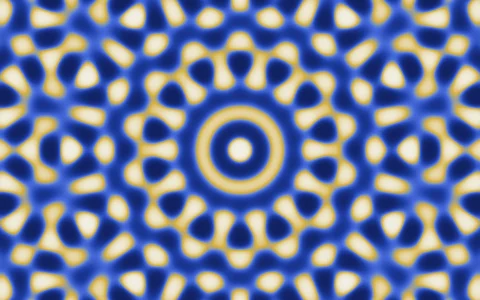
- Six to eight sources in a “ring” build a mandala of standing waves in the centre.
- “Rings — moiré” with a “Wavelength” of 0.012–0.03: big ghostly bands emerge from fine circles.
- “Decay” at 0.6–0.8 turns each source into its own splash, like raindrops in a puddle.
- Put the “Relief” effect on top and the bands become a water surface with highlights; animate at “Speed” 2–4 and the waves run.
 Fractal noise
 Domain warping
 Cellular noise
 Topographic map
 Mesh gradient
 Quasicrystal
 Op art