A crystal is atoms repeating at a fixed step, and such a lattice allows rotations of order two, three, four or six only: regular pentagons will not tile a floor without gaps. So when a rapidly cooled aluminium–manganese alloy showed tenfold diffraction in 1982, it was taken for a mistake. That is how quasicrystals were found: matter ordered yet never repeating. This layer paints their portrait in waves.
How it works
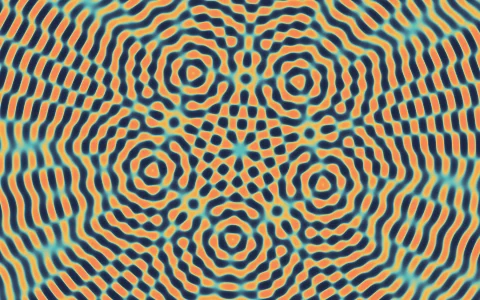
The pattern is a sum of plane waves, corrugations of sine turned by equal angles. With “Symmetry” at n, the waves run in n directions 360°/n apart. Opposite directions give the same wave, so even n needs only n/2 waves and the symmetry is n-fold; odd n has no opposites and the order doubles: five waves draw ten-pointed rosettes, seven fourteen-pointed.
For n = 3, 4 and 6 the sum is periodic: ordinary hexagonal and square lattices. For 5, and for 7 and up, the waves are incommensurate: no shift maps the pattern onto itself, though near-identical rosettes appear everywhere. “Scale” counts wavelengths across the short side. “Style” renders the field “smooth”, in “bands”, in “two colours” or as contour “lines” (their number is “Levels”). The shared phase φ makes whole turns per loop, so the pattern breathes in place. A true quasicrystal can never be a tile, so in tile mode the wave vectors snap to the tile’s lattice, giving what crystallographers call a periodic approximant.
A bit of history
Dan Shechtman saw the forbidden symmetry in an electron microscope on 8 April 1982, published in 1984 and was ridiculed for years; Linus Pauling rejected quasicrystals to the end of his life. The mathematics was ready: in the 1970s Roger Penrose had found non-periodic tilings with two kinds of tile, and in 1981 Nicolaas de Bruijn built them from a pentagrid of five families of parallel lines, or as a projection of a five-dimensional lattice. Such a tiling diffracts into exactly those sharp tenfold peaks. Shechtman won the 2011 Nobel Prize in Chemistry. Natural quasicrystals later turned up in a meteorite from Chukotka, and the girih tiles of the Darb-i Imam shrine in Isfahan (1453) are nearly quasiperiodic.
What to tweak
- Switch “Symmetry” from 6 to 7: the lattice stops repeating.
- 5 gives Shechtman’s tenfold pattern, 8 an Ammann–Beenker-like eightfold one, 12 a twelvefold one.
- “Two colours” at a high “Scale” makes a graphic print; “lines” with 8–12 “Levels” looks engraved.
- “Warp” at 0.2–0.4 bends the waves into moiré silk.
- Put “Quasiperiodic tilings” of the same symmetry on top in “multiply” mode: the tiling meets its portrait in waves.
 Fractal noise
 Domain warping
 Cellular noise
 Topographic map
 Mesh gradient
 Wave interference
 Op art