The kaleidoscope — a tube of mirrors with a pinch of coloured glass — was invented in 1816 by the Scottish physicist David Brewster during his experiments on polarised light. Here the glass is the picture below, cut into a wedge and dealt round the circle like a rose window or a snowflake.
How it works
The angle θ of every point is folded into one wedge 2π/n wide, n being the “Order”. Cn stops there: a pinwheel of n identical turns. In Dn the halves of the wedge also mirror each other, as two mirrors meeting at 180°/n do — so a real kaleidoscope needs a whole n, or a seam shows.
“Droste” works in log-polar coordinates, w = ln r + iθ, where endless nesting becomes plain periodicity: the ring between radii R/k and R repeats with a shift of ln k (k is the “Ring ratio”). In Dn neighbouring rings are reflected as well — an inversion in a circle, a round mirror. The “Escher spiral” shears that plane so one trip round the centre climbs m rings (“Spiral strands”). Back in the plane this is a complex power z ↦ z^α, a conformal map: details turn and scale but never skew.
A bit of history
Patented in 1817, the toy sold by the hundred thousand within months. The mathematics is older: Leonardo da Vinci, planning chapels round a central church, effectively knew that the only finite symmetry groups of the plane are Cn and Dn — Hermann Weyl called it Leonardo's theorem in Symmetry (1952). Droste is a cocoa brand whose 1904 tin shows a nurse with a tray bearing the same tin. In 1956 M. C. Escher made Print Gallery, a twisted nesting with a blank patch in the middle. In 2003 Bart de Smit and Hendrik Lenstra showed his grid is exactly such a complex power, and filled the patch in.
What to tweak
- “Motif X”, “Motif Y” and “Zoom” pick what fills the wedge; a small nudge changes the whole rosette.
- An “Order” of 5 or 7 gives rosettes no periodic wallpaper can have — lattices allow only 2-, 3-, 4- and 6-fold turns.
- For an endless zoom: “Droste” on “rings”, “Spin” 1 — each loop falls exactly one ring deeper, seamlessly.
- It shines over Fractal noise, Reaction–diffusion and Fractal flames: big shapes and fine texture give the wedge plenty to reflect.
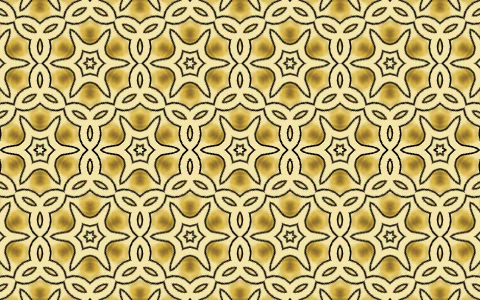 Wallpaper symmetry
 Distort
 Mosaic
 Halftone
 Dither
 Palette recolour
 Relief
 Blur
Blur
 Glow
Glow
 Grain
Grain
 Vignette
 RGB shift