Distortion changes no colours — it only decides where each point fetches its colour from. Think of Photoshop's Twirl, Ripple and Polar Coordinates filters, “tiny planets” made from panoramas, heat shimmer over asphalt, or a fluted glass bathroom door.
How it works
The trick is inverse mapping: rather than moving points of the picture, the effect asks where each screen point takes its colour from, out(p) = src(f(p)). No holes, no overlaps, and any f will do; the “Mode” picks it.
“Noise flow” shifts each point by two independent fractal noises (“Detail” sets the octaves); the shift is tied to the noise size, so “Scale” changes the flow's character, not its strength. “Swirl” turns points round the centre by an angle fading to zero at the “Radius”; the “lens” magnifies or squeezes the middle. “Ripple” sends rings outwards; “wave” is two sine displacements crossing each other. “To polar” rolls the rectangle into a disc — horizontal becomes angle, vertical becomes radius, and the bottom of the picture gathers in the centre; “from polar” unrolls circles back into rows. “Glass blocks” turn every Voronoi cell into a lens, and “reeded glass” is a row of vertical cylinders, each squeezing its strip — or, pushed hard, flipping it.
A bit of history
The idea is as old as anamorphosis: across the floor of Holbein's The Ambassadors (1533) stretches a skull you only recognise from the side. In On Growth and Form (1917) D'Arcy Thompson drew a fish on a grid, bent the grid and got another species — related forms, he argued, often differ by a smooth warp of space. In graphics the key step was Ken Perlin's 1985 paper, whose marble is just stripes, sin x, pushed around by noise. Reeded glass is an Art Deco legacy now back in fashion.
What to tweak
- A negative “Strength” reverses the effect: the swirl turns the other way, the lens becomes concave.
- “Reeded glass” at a “Scale” of 20–40 is that bathroom door; from a “Strength” of about 0.6 each flute flips its strip like a real cylindrical lens.
- With “Speed” 1 the swirl and lens breathe, swinging from +s to −s over a loop, while ripples travel out by whole wavelengths.
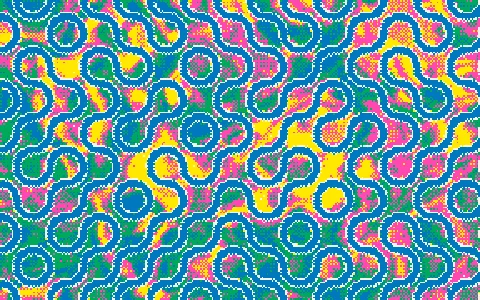
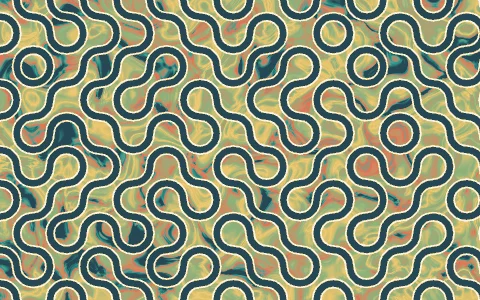
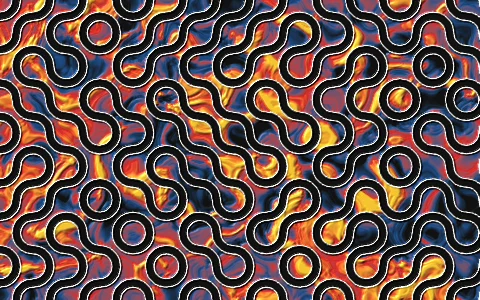
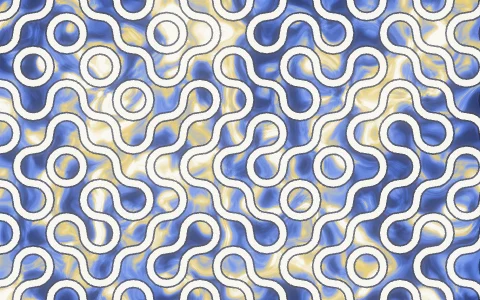
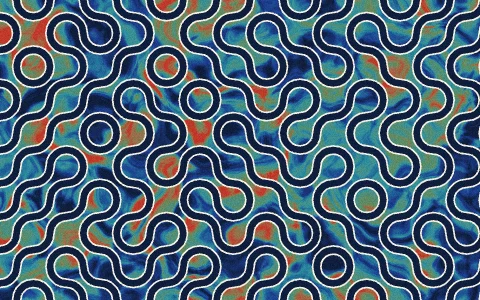
- “Noise flow” shows best on strict geometry: Truchet tiles, Maze and Op art turn into marbling and liquid metal. “To polar” over Ridgelines or plain stripes makes a tiny planet.
 Wallpaper symmetry
 Kaleidoscope
 Mosaic
 Halftone
 Dither
 Palette recolour
 Relief
 Blur
Blur
 Glow
Glow
 Grain
Grain
 Vignette
 RGB shift