Wallpaper, parquet, tiles, fabrics, brickwork: anything that repeats in two directions obeys one of exactly seventeen symmetry groups. The moves are few: shifts, turns by a half, third, quarter or sixth of a revolution, mirrors, and glide reflections (a mirror plus a shift, like footprints in sand). No other way exists: that is a theorem. This effect takes the picture below as a motif and repeats it by the chosen group.
How it works
Every group has a lattice, a parallelogram repeated by shifts, and a fundamental domain, the piece the group’s moves copy across the plane. Working backwards, the effect finds each pixel’s position in the lattice, drops the whole-number part (the shifts), folds the remainder into the fundamental domain, as paper is folded before cutting a snowflake, and reads the picture below there.
Each group lives on one of five lattices: oblique (p1, p2; “Skew” leans it), rectangular (pm to pgg; “Cell ratio” stretches it), centred rectangular (cm, cmm), square (p4 family) and hexagonal (p3 and p6 families). In the names, p is a primitive cell, c a centred one, m a mirror, g a glide reflection, and the digit the highest order of rotation. “Cells” and “Rotation” size and turn the lattice; “Motif X”, “Motif Y” and “Motif scale” choose which piece of the picture below is tiled. In tile mode the cell count is rounded so the ornament wraps seamlessly.
A bit of history
The tilers of Granada’s Alhambra (13th–14th centuries) used so many patterns that scholars still argue whether all seventeen groups are there or only nearly all. Evgraf Fedorov proved in 1891 that there are exactly seventeen, the year he and Arthur Schoenflies independently listed the 230 space groups of crystals. In 1924 George Pólya rederived them independently, with a table of patterns. M. C. Escher, who sketched the Alhambra’s tilings in 1922 and 1936, studied that table; his birds, fish and lizards follow the same wallpaper groups.
What to tweak
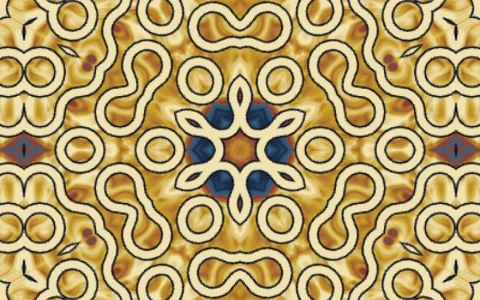
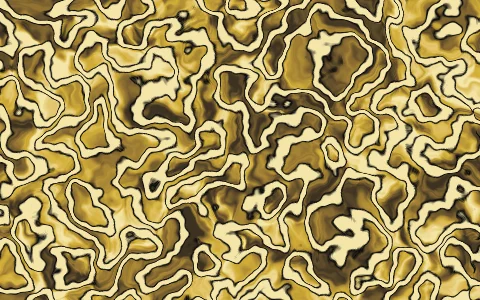
- Over “Fractal noise” with some “Warp”, choose p6m: swirls grow into snowflakes and stained glass (the “Noise kaleidoscope” stack).
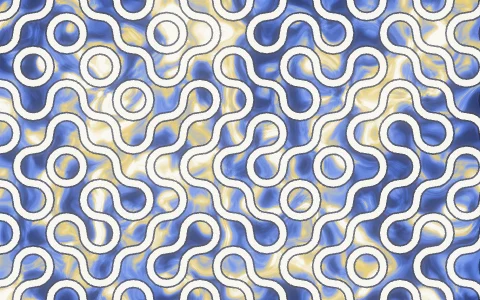
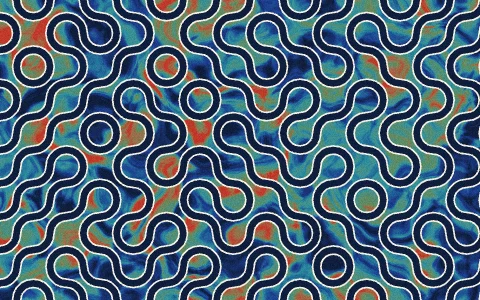
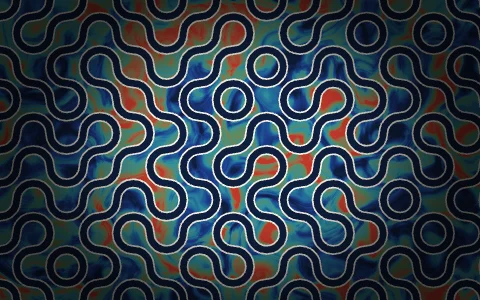
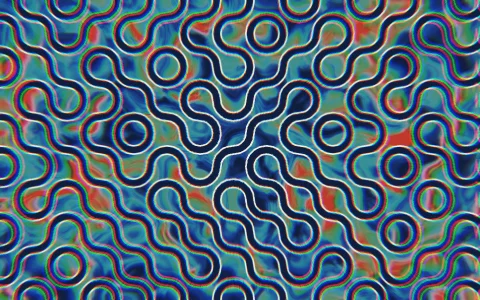
- Over “Truchet tiles”, try p4m and p4g: the random maze turns into strict tilework (the “Truchet ornament” stack).
- Compare groups on one motif: p1 simply repeats it, pg and pgg make walking rows, cmm is the symmetry of ordinary brickwork, p4g spins into pinwheels.
- Drag “Motif X” and “Motif Y”: the ornament rebuilds within the same group.
- Animate the layer below and the ornament breathes; “Spin” turns the lattice itself.
 Kaleidoscope
 Distort
 Mosaic
 Halftone
 Dither
 Palette recolour
 Relief
 Blur
Blur
 Glow
Glow
 Grain
Grain
 Vignette
 RGB shift