Film grain is not a flaw but the very nature of photography: a picture on film is built from tiny specks of silver. Digital sensors have none, so grain is added on purpose — in cinema against plastic smoothness, in graphics against banding. The AV1 codec even strips grain before compression and re-synthesises it on playback, sparing the bits.
How it works
An emulsion is gelatine full of silver halide crystals, mostly bromide. A crystal that caught enough light turns wholly to silver in the developer; the fixer dissolves the rest — a yes-or-no decision. Tone is the fraction p of developed crystals, and the scatter of such a random binary mosaic goes as p(1 − p): largest in the midtones, vanishing in deep shadows and highlights. That is exactly what “Midtones only” does, moving the grain weight from 1 towards 4L(1 − L).
The grain is periodic simplex noise, its “Grain size” set in frame units. “Roughness” adds an octave twice as fine; “Colour” splits the channels by mixing independent noise into each — colour film has three emulsion layers, each with its own grain. When grains are smaller than a pixel their amplitude falls as size/pixel: averaging N independent grains cuts the noise by √N. So a preview looks no noisier than the export. In animation the noise field slides round a circle: new grain every frame, and a loop that closes exactly.
A bit of history
Grain goes hand in hand with speed: a big crystal catches light more easily, so fast films are grainier. In 1935 Selwyn, of the Kodak research laboratory, stated the law that granularity σ measured through an aperture of area S falls as 1/√S — which is why Kodak data sheets quoted RMS granularity through a 48 µm aperture. In the 1980s Kodak brought out T-Grain emulsions with flat, tabular crystals: more area to catch light for the same amount of silver, and so more speed without more grain.
What to tweak
- “Grain size” is in frame units, so an 8K export has the same grain, only crisper: 0.001 is fine-grained stock, 0.003–0.005 a coarse fast film.
- “Colour” at 0 is black-and-white film, 0.3–0.5 colour negative, 1 the chroma noise of a digital sensor at high ISO.
- “Flicker” at 0 freezes the grain for a still; 1–2 makes it boil like a film projection.
- Over smooth Mesh gradient and Fractal noise a light grain (“Amount” 0.1–0.2) kills banding in the export and adds an analogue feel. Over Halftone and Dither it is pointless — they have their own texture.
 Wallpaper symmetry
 Kaleidoscope
 Distort
 Mosaic
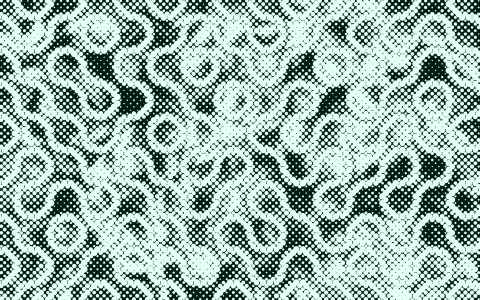 Halftone
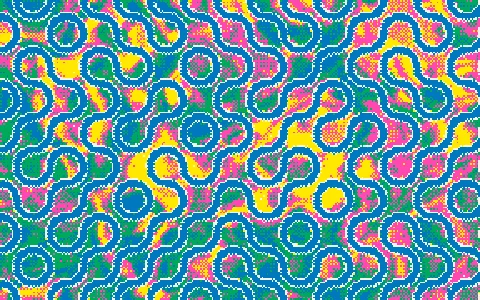 Dither
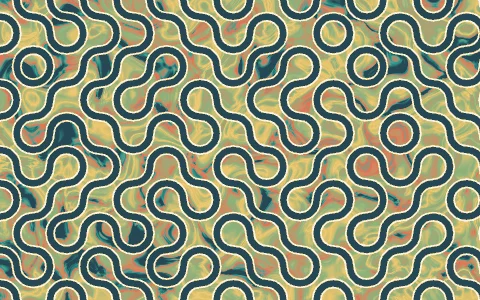 Palette recolour
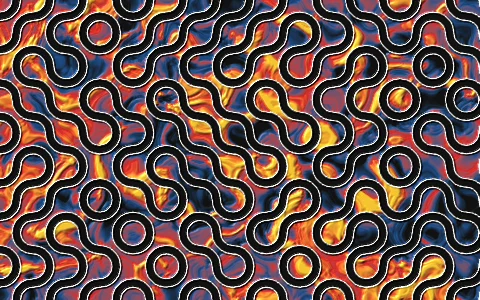 Relief
 Blur
Blur
 Glow
Glow
 Vignette
 RGB shift