When a dish of liquid is shaken vertically at an audio frequency, its smooth surface freezes into ripples: a square grid, hexagonal cells, and at the right frequency eight- and twelve-fold patterns that never quite repeat. These are Faraday waves, the most striking pictures of cymatics.
How it works
Shaking does not push the liquid sideways; it makes gravity pulse. Each surface wave is then a pendulum with varying gravity, and it builds up most when swinging at half the pumping rate, like a child pumping a swing by standing and squatting twice per swing. So the ripples oscillate at half the drive frequency; their spacing follows the dispersion law, ruled in water at audio frequencies by surface tension.
A 100 Hz drive gives water waves about 6 mm long, 440 Hz about 2 mm. The generator adds up N standing plane waves: two make squares, three hexagons, four, five and six quasi-patterns with 8-, 10- and 12-fold symmetry. “Symmetry” “auto” follows the pitch: 55 Hz gives 4, 110 Hz 6, 220 Hz 8, and so on up to 16. The wavelength shrinks more gently than in water, as 1/√f, so the whole keyboard fits the dish. A second, rotated copy takes over as the first passes through zero, so the surface is never flat. As in cymatics photographs, a ring of lamps reflected in the slopes draws bright contours.
A bit of history
Michael Faraday described the ripples in 1831, noting that they oscillate at half the rate of the shaking. T. Brooke Benjamin and Fritz Ursell explained the effect in 1954 as a Mathieu instability. In 1967 the Swiss physician Hans Jenny named such experiments cymatics, from the Greek for “wave”. In the early 1990s experiments produced 8- and 12-fold quasi-patterns, liquid relatives of quasicrystals.
What to tweak
- Step “Notes” by octaves: A1 squares, A2 hexagons, A3 eight-fold, A4 ten-fold, A5 twelve-fold.
- “Light” “ring of lamps” with “Colour” “by slope direction” draws rainbow contours; “by height” gives a relief map.
- More “Wave height”, more lines of light; “Meniscus” near 1 sends rings in from the wall.
- Modulate “Wave height” with sound (source “sound”, band “bass”) and the dish trembles to a track or the microphone. A song arrives from the Studio via “Visualise in Patterns”, a video with sound (“Download” → “Video” → “With sound”) keeps the dance, and “Glow” makes the highlights shine.
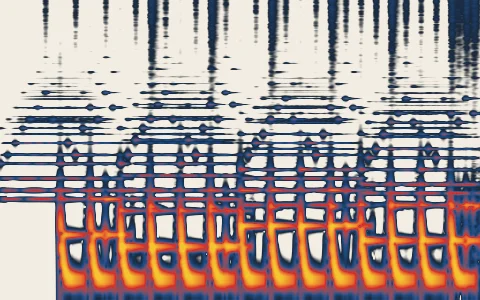 Spectrogram
 Waveform
 Chromagram
 XY oscilloscope
 Chladni figures