A square tile with one simple motif, a diagonal or a pair of arcs, laid down in random orientations gives not a mess but endless winding paths, loops and mazes. They turn up in parquet, floor tiles, book covers and logos, and programmers know them from a Commodore 64 one-liner, 10 PRINT CHR$(205.5+RND(1)); : GOTO 10, which prints random slashes until the screen is an endless maze; it even has a book of its own (MIT Press, 2012).
How it works
The canvas is split into a square grid; “Tiles” sets how many cells fit across the short side. For each cell the generator flips a coin: with probability “Bias” the “Tile” goes down one way, otherwise the other. Arcs are two quarter circles centred on opposite corners, each joining the midpoints of two neighbouring sides. Arc ends always meet arc ends in the next tile, so lines never stop: they close into loops or run off the edge. Diagonals are the 10 PRINT maze. Triangles are Truchet’s original: a square cut along the diagonal, one half filled, in four equally likely orientations (“Bias” does not apply). Hexagons carry three arcs around alternate corners and grow smooth rings and bubbles.
In tile mode the grid wraps around a torus, so the right edge continues the left. “Outline” draws a wider band in “Outline colour” beneath each line, turning lines into ribbons. Being vector, the layer also exports as SVG for a plotter.
A bit of history
In 1704 Sébastien Truchet, a French monk, engineer and one of the designers of the Romain du Roi typeface, published a “Memoir on combinations” with the Paris Academy of Sciences. He studied tiles split diagonally into two coloured halves and the patterns their orientations make. Almost three centuries later, in 1987, the metallurgist Cyril Stanley Smith revisited the memoir in the journal Leonardo and proposed the version with two arcs, which is what most people now call Truchet tiles. Smith was drawn by the topology: curves that never cross and never end.
What to tweak
- “Arcs” with “Line width” around 0.5 and “Outline” at 0.3 give braided ribbons.
- “Bias” at 0.1–0.2 straightens the pattern into near-regular diagonal waves with the odd loop.
- “Colouring” set to “random” with five to seven palette colours makes a patchwork quilt.
- “Triangles” without outline in two contrasting colours: Truchet’s own 1704 tile.
- Put “Wallpaper symmetry” on top with p4m or p4g and the random maze becomes a strict ornament (the “Truchet ornament” stack).
 Archimedean tilings
 Islamic star patterns
 Quasiperiodic tilings
 The aperiodic hat
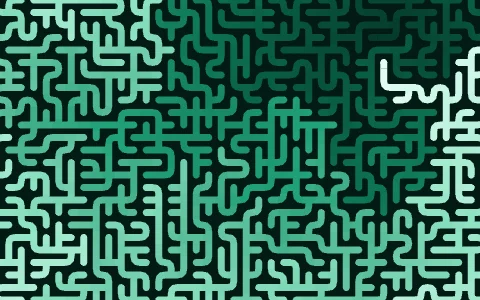 Maze
Maze
 Voronoi and Delaunay
 Circle packing
 Celtic knots
 Weaves