The stars and rosettes woven from straps on the walls of the Alhambra, the tiles of Isfahan and the carved minbars of Cairo look endlessly intricate. Persian craftsmen called such ornament girih, “knot”; Moroccan ones set it in zellige, chipped glazed tile. Yet many grow from one simple rule applied to an ordinary grid of polygons.
How it works
This is Hankin's “polygons in contact” method. It starts from an Archimedean tiling, the “Base tiling”. From every edge midpoint two rays enter each neighbouring polygon at the “Contact angle” θ to the edge. Each ray runs until it meets a ray from the next edge of the same polygon. Every n-gon gets an n-pointed star, rosettes form around the vertices, and rays crossing the edges join into long straps.
“Offset” splits the contact point in two, pushing the rays apart or making them cross. In the “interlaced” style the straps strictly alternate at every crossing, over, under, over, and the ends of the lower strap are cut parallel to the upper one, as in real girih.
A bit of history
The method was described in 1925 by Ernest Hanbury Hankin, a British bacteriologist working in India, best known for showing that Ganges water kills the cholera bacterium. He noticed that such ornament can be drawn on a grid of polygons touching at their edges. In 2005 Craig Kaplan, a computer scientist at Canada's University of Waterloo, turned the idea into an exact algorithm; eighteen years later the same Kaplan co-discovered the aperiodic “hat”. In 2007 the physicists Peter Lu and Paul Steinhardt found that many medieval patterns are assembled from five line-decorated girih tiles: a decagon, a pentagon, an elongated hexagon, a “bowtie” and a rhombus. On an arch of the Darb-i Imam shrine in Isfahan (1453) they are laid almost quasiperiodically, five centuries before Penrose. M. C. Escher drew inspiration for his tessellations from visits to the Alhambra in 1922 and 1936.
What to tweak
- Small “Contact angle” values press the straps against the base edges; values near 88° stretch the star tips into needles.
- A positive “Offset” sends the rays around the vertices; a negative one crosses them right next to the edge.
- “Base tiling” 4.6.12 or 3.12² gives twelve-pointed stars, and 6³ at 60° gives hexagrams.
- “Straps” “band” or “line” and “Fill” “stars” range from strict line art to coloured tilework.
- The “Relief” effect on top turns the strapwork into carved plaster, as in the Alhambra.
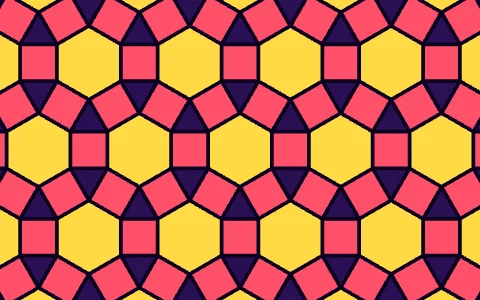 Archimedean tilings
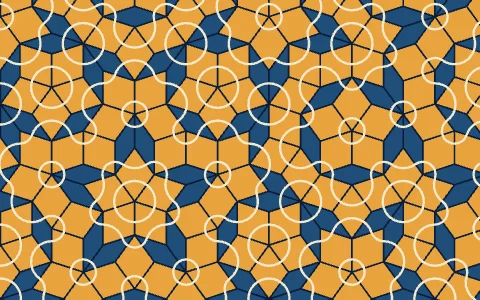 Quasiperiodic tilings
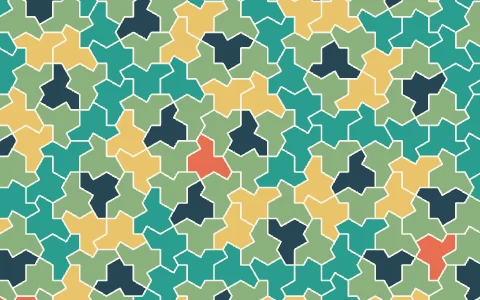 The aperiodic hat
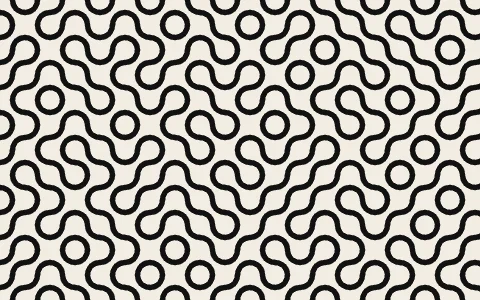 Truchet tiles
 Maze
Maze
 Voronoi and Delaunay
 Circle packing
 Celtic knots
 Weaves