A floor of identical regular polygons can only be laid with triangles, squares or hexagons: a regular pentagon has 108° corners, and no number of them makes 360°. If different polygons are allowed but every vertex must look alike, with the same shapes in the same order, there are exactly eleven ways: the Archimedean tilings.
How it works
A tiling is named by reading around a vertex: 4.8² is a square and two octagons, 3.4.6.4 a triangle, a square, a hexagon and another square. The angles around the point must come to exactly 360°.
Counting the order of the polygons, the angle equation has 21 solutions, but only eleven extend over the plane with every vertex alike, and some, like 3.7.42, never get past a single vertex. They are three regular and eight semiregular tilings; 3⁴.6 comes in two mirror-image forms. The generator builds each from its exact unit cell, so tiles repeat seamlessly.
“Dual (Laves)” puts a point in the centre of every polygon and joins the centres of neighbours. Each vertex becomes a face, and all tiles of the new tiling are identical: 3.6.3.6 turns into rhombi that the eye stacks into cubes, 3².4.3.4 into the pentagons of the Cairo pavement.
A bit of history
Johannes Kepler first described all eleven in Harmonices Mundi (1619), the same book in which he reconstructed Archimedes' thirteen semiregular polyhedra and stated his third law of planetary motion. Hence the name: like the Archimedean solids, these tilings have regular faces and identical vertices. The duals bear the name of the German crystallographer Fritz Laves. The Cairo tiling really paves Cairo's streets; the tumbling cubes are familiar from parquet and quilts. The hexagonal grid 6³ is also the most economical: of all ways to divide the plane into cells of equal area it has the least perimeter. Thomas Hales proved this “honeycomb conjecture” in 1999.
What to tweak
- “Dual (Laves)” on 3.6.3.6 and 3².4.3.4 gives the cubes and the Cairo pentagons.
- “Colouring” “by polygon” gives triangles, squares and hexagons their own colours; “by position” gives every tile of the unit cell its own, and hidden symmetry shows up.
- “Grout” and “Rounding” turn the tiling into glazed ceramics or a scatter of jelly sweets.
- “Colouring” “lines only” with a thick “Outline” makes a lattice ready for SVG, a plotter or a laser cutter.
- Put “Islamic star patterns” with the same “Base tiling” on top to see which edges the stars grow from.
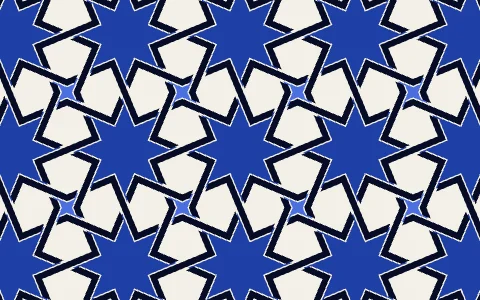 Islamic star patterns
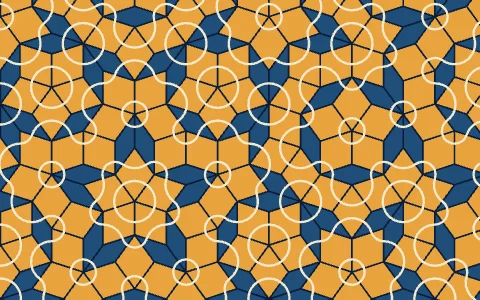 Quasiperiodic tilings
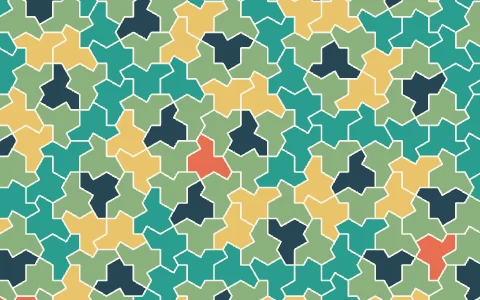 The aperiodic hat
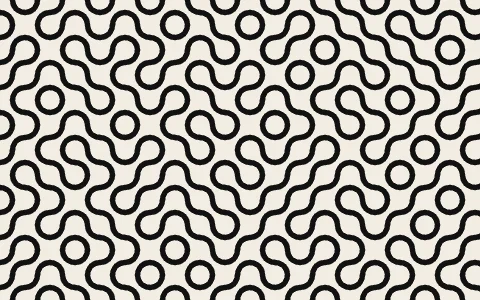 Truchet tiles
 Maze
Maze
 Voronoi and Delaunay
 Circle packing
 Celtic knots
 Weaves