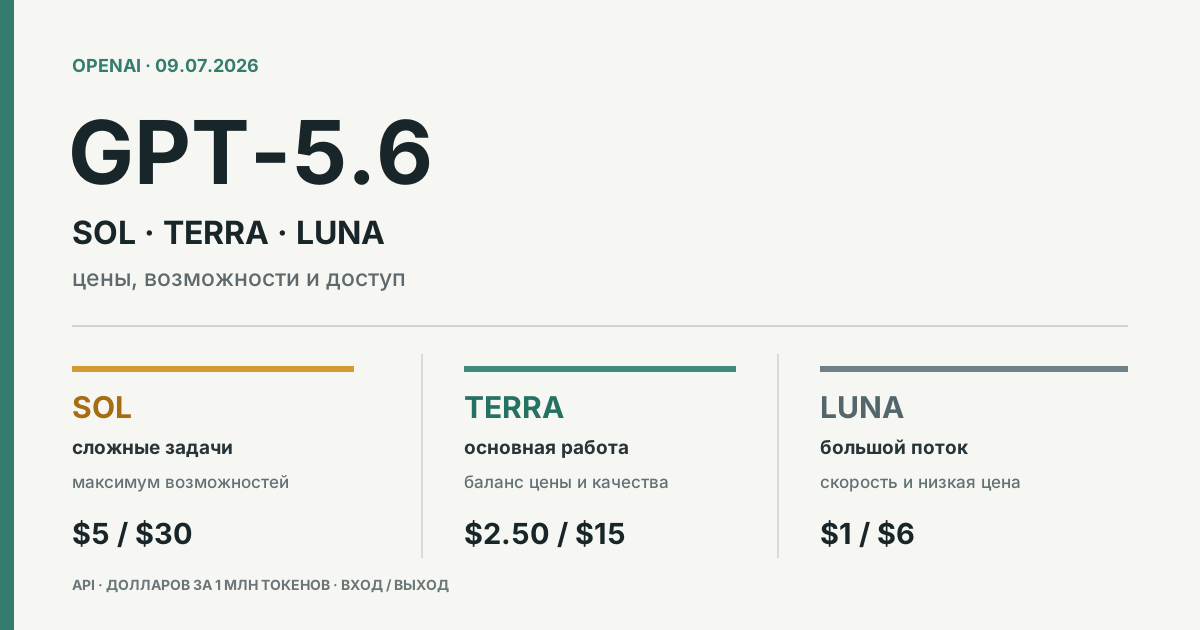
OpenAI started rolling out GPT-5.6 globally today. This is not one new model but a family of three tiers: Sol, Terra, and Luna. The naming is a little celestial, but the logic is straightforward: more capability and compute at the top, more speed and lower cost at the bottom.
The rollout began on July 9 and will continue gradually for the next 24 hours. If GPT-5.6 has not appeared in ChatGPT or Codex yet, that does not necessarily mean there is a problem with your account.
The short version
- Sol is the flagship for difficult coding, research, cybersecurity, and long-running agent work.
- Terra is the middle tier: competitive with GPT-5.5, but half the API price.
- Luna is the fastest and most affordable option for high-volume work.
- Sol adds
maxandultraeffort settings.ultracoordinates four parallel agents by default. - Access depends on the ChatGPT or Codex plan. All three models are available through the API at token-based prices.
Sol, Terra, and Luna
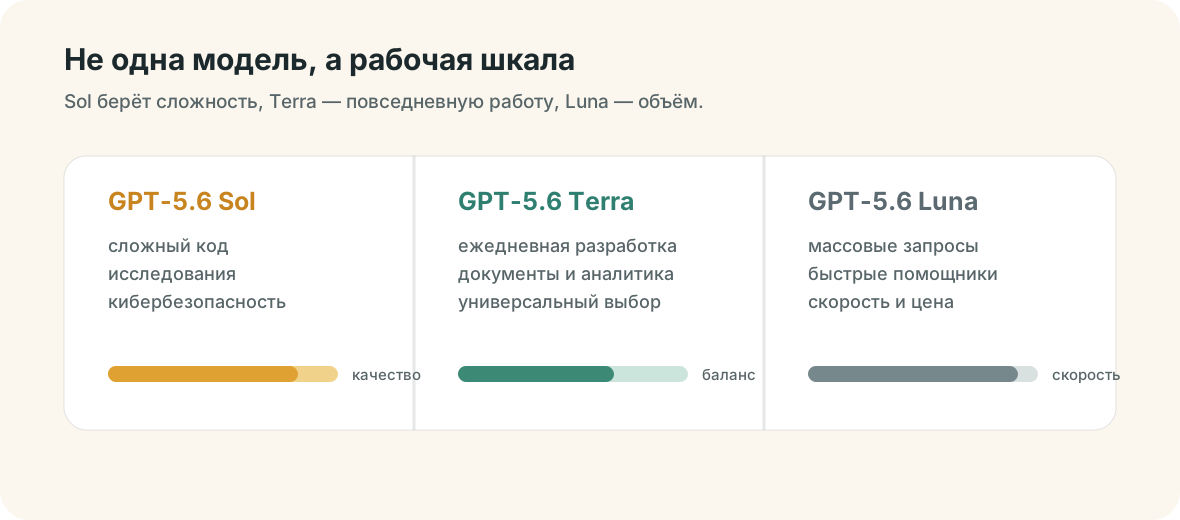
OpenAI is separating the generation number from the capability tier. GPT-5.6 identifies the generation, while Sol, Terra, and Luna are durable capability tiers that can advance on their own cadence.
| Model | Best for | OpenAI's positioning |
|---|---|---|
| GPT-5.6 Sol | Complex code, research, computer use, cybersecurity, long-running tasks | The strongest model in the family, with better tool use, interface judgment, and multi-step execution |
| GPT-5.6 Terra | Everyday development, documents, analysis, internal tools | Competitive with GPT-5.5, at a lower price and with faster execution |
| GPT-5.6 Luna | High-volume short requests, classification, fast assistants | The fastest and most cost-efficient model in the lineup |
The difference is not only answer quality. Sol can spend more time reasoning, run more checks, and split work into parallel branches. Luna is designed for throughput and predictable cost. Terra looks like the practical default for a team that does not need a frontier model on every step.
What developers get
Coding and agent work
Sol is aimed at tasks that go beyond completing a function. It can inspect a repository, call tools, edit several parts of a project, run checks, and return to fix what failed. OpenAI highlights Terminal-Bench 2.1 and DeepSWE, which test command-line workflows and long-running engineering work in real codebases.
GPT-5.6 adds a max effort setting that gives the model more time to reason, explore alternatives, and verify its work. ultra goes further by coordinating four agents in parallel and synthesizing their results. That is not free acceleration: more agents mean more tokens. But for a difficult refactor or a long research task, parallel work can finish sooner than one agent moving step by step.
The Responses API also adds Programmatic Tool Calling. The model can write a small in-memory program, use it to coordinate tools, filter a large amount of intermediate data, and keep only the useful results in context. For tools that return thousands of lines, this matters more than a flashy demo: less context, less latency, and a smaller bill.
Computer use, documents, and interfaces
OpenAI reports a large improvement in computer use. GPT-5.6 can inspect what appeared on screen, then refine the result instead of stopping after generating code. That is relevant to frontend work, presentations, spreadsheets, and documents.
The shift is simple: the output is supposed to be a finished artifact, not just a file. The agent should notice a broken table, a missing slide block, or an awkward mobile layout. The evidence is still mostly OpenAI's own evaluations and examples, so real projects still need their own tests, screenshots, and human review.
Science and cybersecurity
GPT-5.6 Sol shows strong gains on scientific and cybersecurity tasks. OpenAI says it is better at finding and fixing vulnerabilities, as well as supporting biology and chemistry research.
That is also the sensitive part of the release. The same capability can help a defender or be turned against a system. OpenAI added stronger monitoring, layered safeguards, and a Trusted Access for Cyber program. Verified participants can get more precise access for defensive workflows such as vulnerability triage, malware analysis, detection engineering, and patch validation.
Pricing
These are OpenAI API prices per 1 million tokens. Input is the prompt and context; output is the generated response.
| Model | API ID | Input | Output | Typical role |
|---|---|---|---|---|
| GPT-5.6 Sol | gpt-5.6-sol | $5 | $30 | Difficult work where quality matters most |
| GPT-5.6 Terra | gpt-5.6-terra | $2.50 | $15 | The team's main working model |
| GPT-5.6 Luna | gpt-5.6-luna | $1 | $6 | A high-volume stream of fast requests |
GPT-5.6 also introduces more predictable prompt caching. Developers can set explicit cache breakpoints, with a 30-minute minimum cache lifetime. Cache writes cost 1.25 times the uncached input rate, while cache reads keep the 90% discount. For long-running agents, repeated context does not have to be paid for in full every time.
Still, price per million tokens is not the whole story. One Sol run may finish a task that Terra would need several attempts to solve, while Luna may require extra human review. The useful number is the cost of a finished result, not just the cost of one call.
Who gets access
ChatGPT
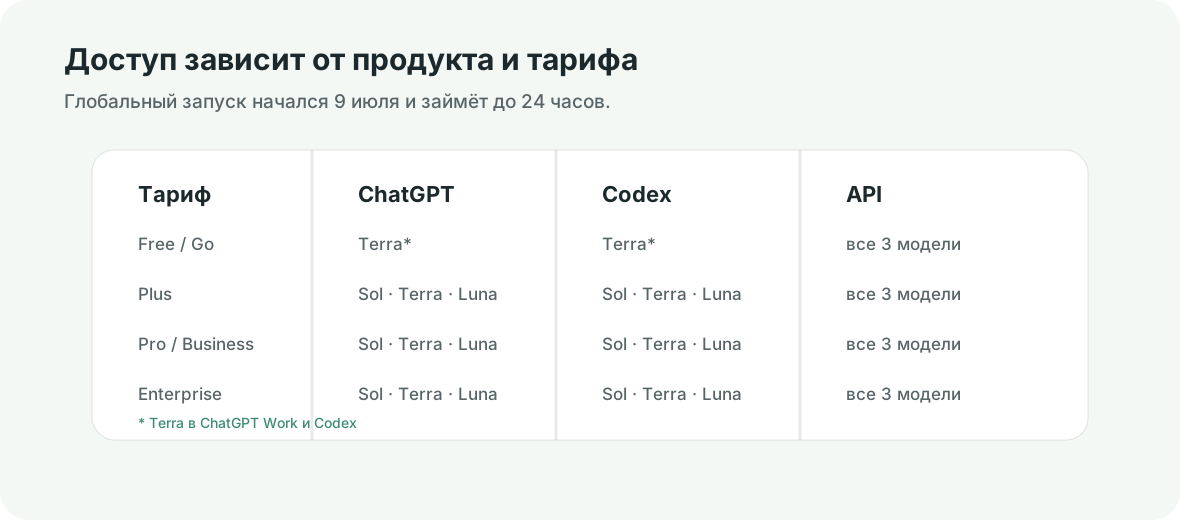
- Plus, Pro, Business, and Enterprise users get GPT-5.6 Sol at medium and higher effort levels.
- Pro and Enterprise users can select GPT-5.6 Sol Pro for the highest-quality results on complex work.
- Free and Go users get GPT-5.6 Terra in ChatGPT Work and Codex.
- In ChatGPT Work, Plus, Pro, Business, and Enterprise users can choose Sol, Terra, and Luna.
ultrais available to Pro and Enterprise users.
Codex
Codex users on Plus and higher plans can choose between Sol, Terra, and Luna, with ultra available from Plus upward. Free and Go users get Terra as the base model. The max setting is available to everyone who has GPT-5.6 access in ChatGPT Work or Codex.
API
Developers can use all three models: Sol, Terra, and Luna. Programmatic Tool Calling is available in the Responses API, while multi-agent support is initially in beta. One important detail: API access and Codex access are separate permissions. Approval for one organization or workspace does not automatically grant the other.
The global rollout starts today and proceeds over the next 24 hours. So the right answer to “why don't I have GPT-5.6 yet?” is “check again later,” not “your account is blocked.”
What changes
The interesting part of GPT-5.6 is not just the names or another list of benchmark records. OpenAI is selling a range now: Sol for hard problems, Terra for the main workload, Luna for scale. That looks more like normal engineering economics than a race to crown one model as the only winner.
For developers:
- Do not put Sol everywhere. Use the flagship where errors are expensive or the task is genuinely hard.
- Test Terra first. If it covers most of the work, the price difference compounds quickly.
- Use Luna for volume. Classification, routing, simple transformations, and fast suggestions should not cost like research.
- Count the whole run.
ultra, tools, retries, and long context can consume more budget than the model price suggests. - Build your own evals. OpenAI's results are a useful reference, but your repository, data, and failure modes make the final decision.
GPT-5.6 matters because it shows where model releases are going: a model is becoming part of a working system with permissions, cost, parallel agents, observability, and risk controls. Smarter is useful. The more practical question is which kind of smart model belongs on this particular job.
Sources: GPT-5.6 launch · GPT-5.6 preview · OpenAI access and pricing help · GPT-5.6 system card