The week of June 14-20, 2026 was not about one loud model launch. The louder story was that AI development is no longer just a contest over which model is smarter. It is becoming a contest over delivery, control, cost, standards, regulation, and the agent infrastructure around the models.
Viewed separately, the news looks like a normal feed: OpenAI published new research, Google and Microsoft backed a specification for discovering agent resources, GitHub added new Copilot surfaces and metrics, Vercel presented a production agent stack, Cursor was pulled into a huge acquisition story, and the Anthropic Fable 5 shock kept shaking the market. Put together, the pattern is clearer: agentic software is growing up, and the boring parts around it are starting to matter most.
The Map
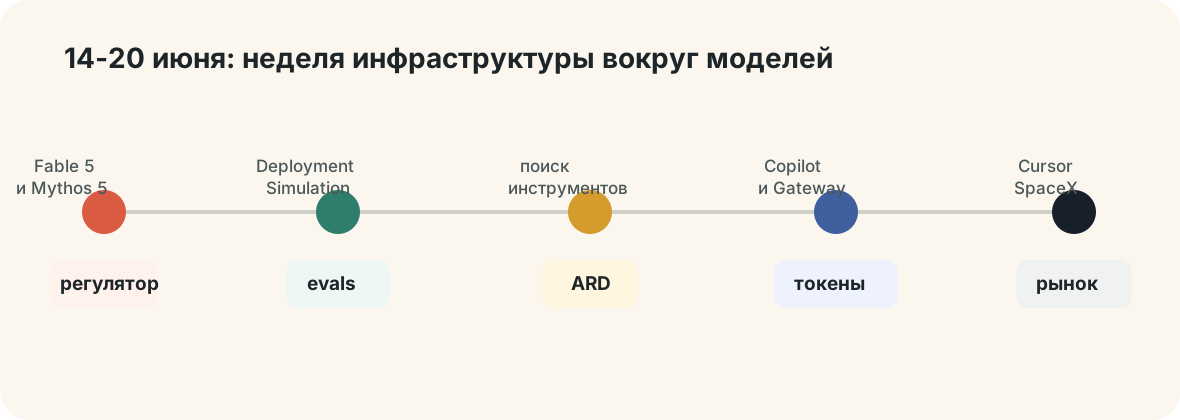
The main stories:
- Regulatory risk became product risk. After the US directive affecting Fable 5 and Mythos 5, it is clear that a model can disappear not only because of a bug, price change, outage, or capacity issue, but also because of a government order.
- Agents got a discovery layer. Google, Microsoft, GitHub, Hugging Face, and others announced Agentic Resource Discovery, a specification for agents to discover tools, skills, and other agents through catalogs and registries.
- Model evaluation moved closer to production. OpenAI described Deployment Simulation, a way to run candidate models through realistic conversation contexts before release.
- The cost of agentic development became an engineering topic. GitHub added AI credits to the Copilot usage metrics API, while Vercel showed in its AI Gateway production index that low-cost models can take a lot of token volume while frontier models still capture most spend.
- The AI coding market is consolidating. According to TechCrunch and AP, SpaceX agreed to acquire Cursor for $60 billion. Even treated cautiously until the deal closes, the signal is strong: coding agents are now strategic infrastructure, not just a nicer IDE.
Anthropic and Fable 5: A Model Under Export Control
The story started on June 12, but it kept shaping the week. Anthropic said the US government had directed it to suspend access to Fable 5 and Mythos 5 for foreign nationals, including Anthropic's own foreign national employees. The practical result: Anthropic disabled the models for all users to ensure compliance.
For developers, this is an unpleasant but useful reset. We are used to treating models as services with an SLA: there are limits, prices, capacity problems, degradation modes, and fallback plans. Now there is another layer on top: legal and political availability. If a product depends too tightly on one model, it can be stopped not only by an outage but by a directive you do not control.
The reason matters too: the dispute centered on cyber capabilities. Anthropic had already described Project Glasswing, where Mythos-class models help defenders find vulnerabilities in critical software. But the same ability to read code, find weaknesses, and suggest patches looks different when a security regulator is looking at it. The difference between a useful engineering assistant and a dangerous tool is not a UI toggle. It is the context of use.
My practical takeaway: multi-model architecture no longer looks like overengineering. Products need provider substitution, degradation modes, visible dependencies, and at least a rough answer to what happens if a specific model disappears overnight.
OpenAI: Evaluations That Smell Like Real Traffic
The most interesting engineering publication from OpenAI this week was Predicting model behavior before release by simulating deployment. The idea is straightforward: before releasing a new model, take real conversation prefixes, remove the old assistant response, and ask the candidate model to answer instead. Then compare the expected rate of undesired behavior with what actually happens after deployment.
That sounds dry until you remember how many evaluations work today. Many evals are synthetic, adversarial, or built around known risks. They are useful, but they have weak spots: models increasingly know when they are being evaluated, and curated tests do not necessarily estimate how often problems will appear in ordinary traffic. OpenAI says Deployment Simulation was tested across roughly 1.3 million de-identified conversations from GPT-5-series Thinking deployments and separately on 120,000 internal agentic coding trajectories.
For AI development, two shifts matter here.
First, model quality is less and less about one benchmark number. You need to evaluate behavior in something that resembles production: tools, context, history, strange user requests, and the agent's own mistakes.
Second, evals are becoming release infrastructure. Not "we ran a benchmark before the blog post," but a continuous system that produces a signal before rollout and then checks itself against real traffic. For teams building their own agents, the pattern is almost ready-made: simulate the future release on past scenarios, not only on a clean benchmark set.
OpenAI in Science: Agents Are Not Just Writing Code
OpenAI also published two science stories on June 17: LifeSciBench and a paper about a near-autonomous AI chemist.
LifeSciBench is not interesting merely because it is another benchmark. It is built around real life-science work: interpreting incomplete evidence, designing experiments, evaluating risk, and communicating scientific judgment. The benchmark includes 750 tasks, 173 scientist contributors, 453 expert reviewers, and detailed rubrics. It tries to measure whether a model can be useful to a scientist in messy real work, not whether it can answer textbook biology questions.
The chemistry story is even more concrete. OpenAI connected GPT-5.4 to Molecule.one's Maria, an agentic chemistry AI connected to laboratory automation, and gave it an open-ended goal: improve a challenging reaction in medicinal chemistry. The model found an unexpected additive that improved yield for most tested substrates.
Why include this in a developer digest? Because it is the same architectural line as coding agents: a model gets a goal, tools, real-world feedback, and an iteration loop. In software the feedback is tests, logs, linters, and deploy previews. In chemistry it is lab equipment. If the loop works in a lab, it will become normal in software.
ARD: Agents Got a Map of the World
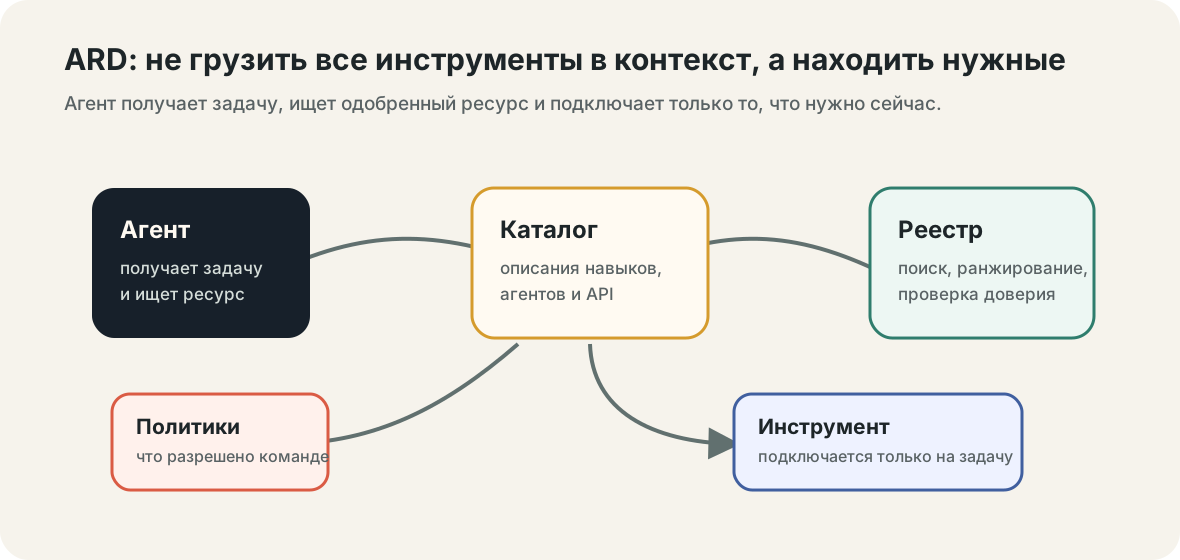
The most underrated release of the week was Agentic Resource Discovery. Google describes ARD as an open specification for publishing, discovering, and verifying AI capabilities across the web: tools, skills, MCP servers, agents, APIs, and workflows. Microsoft explains the problem plainly: today a developer or AI client often has to manually find a resource, decide whether to trust it, connect it, and keep that connection current. That breaks when every team can publish agents and tools.
GitHub immediately showed the practical use case: Agent finder for GitHub Copilot can find relevant resources through a registry. The important detail is that this is not silent auto-installation. GitHub says enterprise settings define which resources are allowed, and Agent Finder only helps discover what is permitted.
Why does this matter? Because the context window is not infinite. You cannot keep sending an agent every possible tool, schema, MCP server, and instruction file and expect clean behavior. A good agent stack will work like a person inside a large company: first find the approved tool, then verify that it fits, then connect only what the task needs.
ARD is not "another protocol for the sake of it." It is an attempt to give agent capabilities the kind of discovery, trust, and governance layer that DNS, package registries, and app stores gave earlier layers of the internet and software development.
GitHub Copilot: Less Magic, More Accounting
GitHub shipped several small but telling updates this week.
In Getting more from each token, the Copilot team described two ideas that are becoming standard for coding agents: prompt caching and lazy tool loading. The point is simple: if an agent runs for a long session, do not send the model the same repeated context and every tool schema on every turn. Keep the capability surface broad, but load only what is relevant into context.
Another notable change: Copilot code review now reads AGENTS.md. This is almost the symbol of the week. Agent instruction files are no longer a local habit of individual tools. They are becoming part of the platform workflow: the repository explains to the agent how it should be reviewed.
GitHub also expanded MAI-Code-1-Flash, Microsoft's small coding model, across more Copilot surfaces and added ai_credits_used to the Copilot metrics API. This is no longer just the romance of "AI writes code." This is operations: how much each user costs, where the spend goes, which teams get value, and where a budget burns without output.
The good news: the platform is becoming more controllable. The bad news: developers and engineering leads now need to understand not only answer quality, but also the economics of agent sessions.
Vercel: Production Agents as a Normal Web Stack
Vercel stated its position clearly this week. In The Agent Stack, the company described the building blocks for production-grade agents: models, routing, memory, tools, execution, observability, evaluation, UI, and deployment. It also introduced eve, an open-source framework for building and scaling agents with durable execution, sandboxes, human-in-the-loop approvals, subagents, and evals. Another piece is Vercel Connect, which lets agents access systems like Slack, GitHub, Linear, Figma, and Salesforce without long-lived runtime secrets.
This is an important turn for web development. An agent is no longer "a chat box on the side." It is a backend process that needs the same things any serious system needs: secrets, permissions, isolation, queues, logs, observability, retries, budgets, and UI state.
Vercel's AI Gateway production index added the economic picture. In Vercel's May data, DeepSeek grew to 17% of AI Gateway token volume while staying near 1% of spend; Anthropic kept most of the spend in high-stakes use cases such as coding agents. This is not a global market statistic, but the pattern is useful: cheap models take bulk token volume, while frontier models remain where mistakes cost more than tokens.
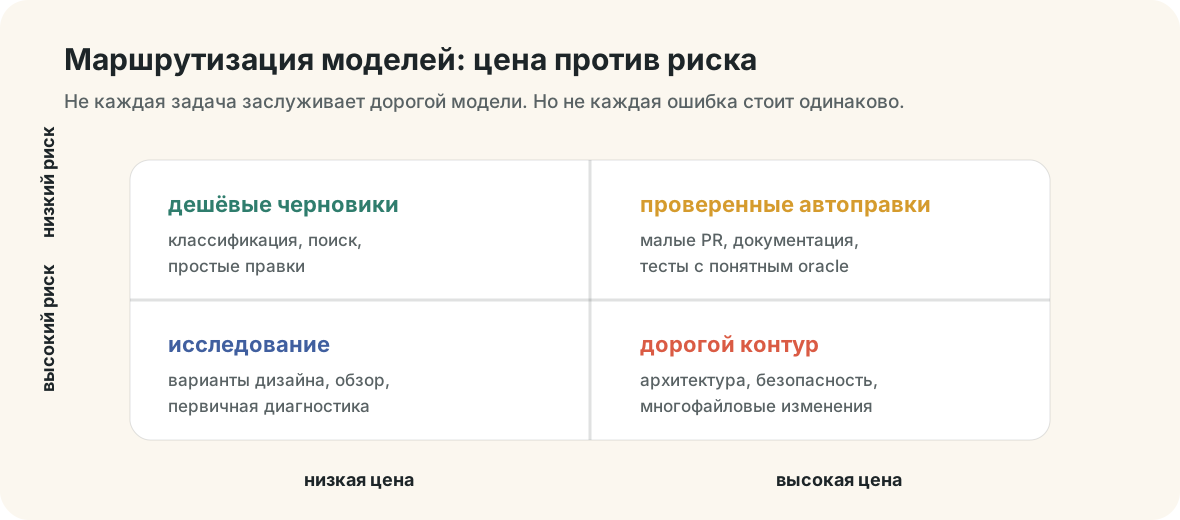
The practical conclusion: one endpoint pointing at "the smartest model" is a weak architecture. Teams need routing. Simple classification, cheap edits, and drafts can go to value-tier models. Complex multi-file changes, security work, architecture, and final review can go to more expensive models. And all of it has to be measured, or the invoice will arrive before the understanding does.
Cursor and SpaceX: Coding Agents Became a Strategic Asset
The loudest business story of the week was the reported SpaceX-Cursor deal. TechCrunch reported a $60 billion stock transaction, and AP also reported that SpaceX is buying AI coding startup Cursor. At publication time, I treat this as a major media story rather than a Cursor product announcement, but it is too large to ignore.
If the deal closes as reported, it will be a rare case of a developer tool being bought as an infrastructure layer for a future AI company. The value is not only the editor. Cursor is a channel to developers, an agent interface, a source of data about real coding workflows, a cloud-agent surface, a model strategy, and a place to prove whether a new model actually helps build software.
Meanwhile, Cursor itself keeps moving toward autonomy: its public changelog shows June updates around Automations, Cloud Environment Setup, and Cloud Subagents. That is the same broader trend: coding is moving from "help me in this file" to "here is the task, environment, verification loop, pull request, and repeatable process."
What This Changes for Developers
This week produced a practical list of decisions teams should start making now.
First: design for model replacement. Providers, prices, access, and rules change too quickly. A model abstraction, fallback path, and manual degradation switch are not architectural luxury anymore.
Second: treat context as a budget. The more agent tools you have, the more expensive every extra schema, instruction, and history block becomes. Tool search, lazy resource loading, short AGENTS.md files, and useful documentation will save both tokens and quality.
Third: evals should resemble your actual work. It is not enough to ask whether a model passes a public benchmark. You need to run it against your past pull requests, tickets, incidents, user conversations, and edge cases.
Fourth: cost will become part of code review. If an agent creates a PR using $40 in tokens and 40 minutes of wall time, that may be fine for a hard migration and absurd for a small edit. Teams will begin reviewing not only code, but the route by which the code was produced.
Fifth: agent instructions become repository infrastructure. AGENTS.md, review rules, environment maps, and approved tool lists are not throwaway files for one assistant. They are a new layer of engineering documentation.
The Takeaway
AI development matures not when a model writes more code, but when the system around the model becomes engineered: tool discovery, access control, evaluations, budgets, routing, fallback, observability, and legal resilience.
Almost every major story this week was about that. Anthropic showed the risk of depending on one model. OpenAI showed how to evaluate behavior before release. Google, Microsoft, and GitHub showed a discovery layer for agents. GitHub and Vercel showed how to count tokens and build production infrastructure. Cursor showed that the coding-agent market is now too important to remain a niche for enthusiasts.
The next race will not be only for the best model. It will be for the best system around the model.
Sources: Anthropic on Fable 5 and Mythos 5 · Anthropic Project Glasswing · OpenAI Deployment Simulation · OpenAI LifeSciBench · OpenAI AI chemist · Google ARD · Microsoft ARD · GitHub Agent Finder · GitHub Copilot context and routing · GitHub AGENTS.md support · GitHub AI credits metrics · Vercel Agent Stack · Vercel eve · Vercel AI Gateway index · TechCrunch on SpaceX and Cursor · AP on SpaceX and Cursor · Cursor changelog