This week in AI development was less about shiny model demos and more about the hard parts of running agents for real: access, cost, evaluation, security, context, workflow, and infrastructure.
OpenAI previewed GPT-5.6 Sol, expanded Daybreak and Patch the Planet, and showed its Jalapeño inference chip with Broadcom. Anthropic launched Claude Tag in Slack. GitHub published results from the Copilot agentic harness. Google pushed Jules evaluation and A2A multi-agent patterns. Vercel released AI SDK 7. The shared message is simple: agents are leaving the demo stage and entering production.
The Short Version
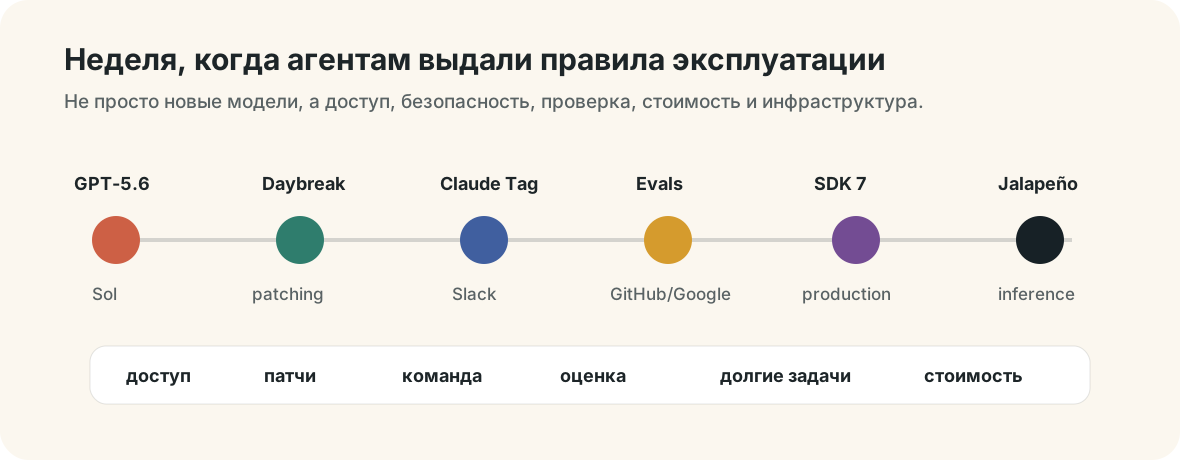
- GPT-5.6 Sol is not just a model launch. OpenAI pairs stronger coding, science, and cybersecurity capability with a limited preview, government coordination, safeguards, and new access tiers.
- Security agents are moving from findings to fixes. Daybreak and Patch the Planet focus on vulnerability validation, patches, tests, and maintainer-friendly workflows.
- Claude Tag puts the agent inside the team channel. Anthropic is moving Claude from private chat into shared Slack workflows.
- GitHub and Google are evaluating the harness, not only the model. Agent quality depends on planning, tool use, token efficiency, environment feedback, and knowing when to act.
- Vercel AI SDK 7 adds production plumbing. File and skill references, approvals, durability, and telemetry matter more as agents become multi-step systems.
- Jalapeño shows that inference is product strategy. Latency, cost, capacity, and energy are now part of the model race.
GPT-5.6 Sol: A Launch With Guardrails
OpenAI previewed GPT-5.6 Sol on June 26. The family introduces Sol as the flagship model, Terra as a balanced tier, and Luna as the faster, cheaper tier. For developers, the interesting parts are stronger coding performance, a new max reasoning effort, and an ultra mode that uses subagents for complex work.
But the release mechanics matter as much as the model. After the Anthropic Fable 5 and Mythos 5 episode earlier this month, frontier model launches now carry access policy, cyber safeguards, monitoring, and staged availability. OpenAI is starting with trusted partners and says broader access should follow.
The practical point: do not choose a model by benchmark alone. Look at access terms, price for long tasks, fallback options, regional availability, and how likely the provider is to change availability under external pressure.
Daybreak: From Finding Bugs to Landing Fixes
OpenAI expanded Daybreak on June 22 and introduced Patch the Planet with Trail of Bits for open-source maintainers.
The important shift is from vulnerability discovery to remediation. Finding a suspicious code path is only the first step. Real security work means proving reachability, reproducing the issue, preparing a patch, adding tests, and giving maintainers a reviewable trail.
That also raises the hard question: the same workflow can help defenders or attackers. The current answer is not magic. It is scoped access, verified users, logs, human review, and controlled environments. AI security tooling is starting to look like production access management.
Claude Tag: The Agent Moves Into Slack
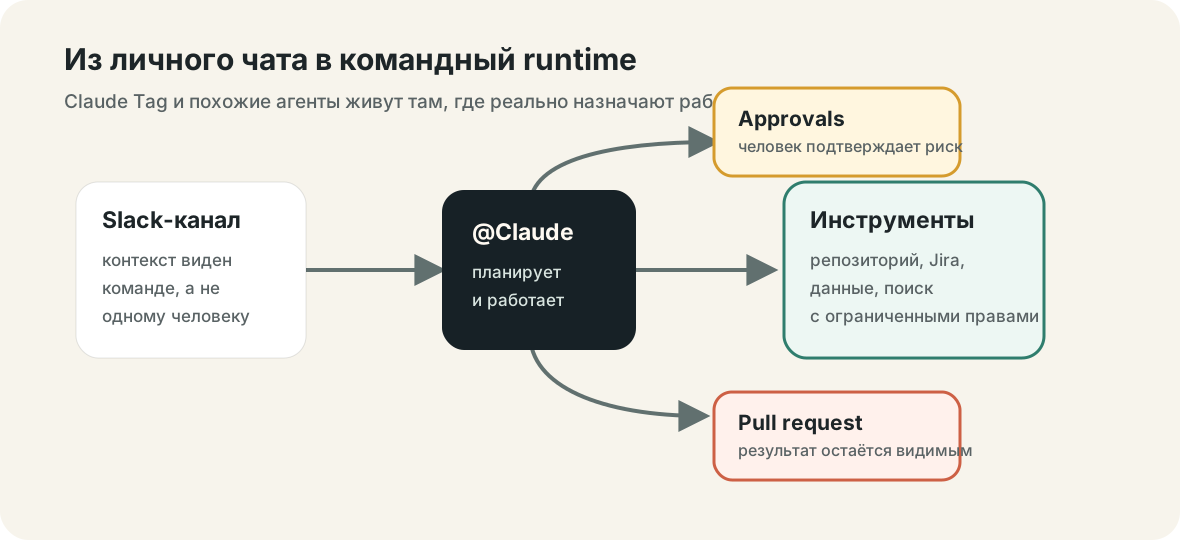
Anthropic launched Claude Tag on June 23. You can mention @Claude in Slack and delegate work inside the channel. That sounds like a small integration, but the interface shift is large.
Private chat is one person asking and one model answering. Slack is shared context, visible delegation, visible results, and team memory. Claude becomes less like a private assistant and more like a teammate in a channel.
Anthropic says 65% of its product team's code is created by an internal version of Claude Tag. That is a company self-report and should be read carefully, but the direction is real: AI coding is spreading out of the IDE into the places where work is assigned.
Codex as a Form of Work
OpenAI's How agents are transforming work report makes Codex look less like a developer tool and more like a general work interface.
OpenAI says that by May 2026, 70.2% of sampled individual users made at least one Codex request estimated to exceed one hour of human work, and 25.6% made one estimated to exceed eight hours. Inside OpenAI, Codex became the primary AI tool not only for engineers but also for legal, finance, and recruiting. At the 99th percentile, internal users generated more than 60 hours of Codex agent turns per day across parallel agents.
This does not mean every non-developer becomes a software engineer. It means more people can delegate small automations, data cleanup, internal tools, and technical execution that used to wait for engineering help. That is useful. It also creates new technical debt.
GitHub and Google: The Harness Matters
GitHub published an evaluation of the Copilot agentic harness on June 25. The key point is that Copilot can choose among 20+ models, but performance and efficiency depend on the whole harness: planning, tool calls, context, token use, and environment feedback.
Google made a related argument in Measuring What Matters with Jules and its ADK plus A2A multi-agent pipeline. Agents should be evaluated not only on whether they fix a clearly stated task, but on whether they understand what matters, when to interrupt, when to stay silent, and how to hand work to another agent without polluting context.
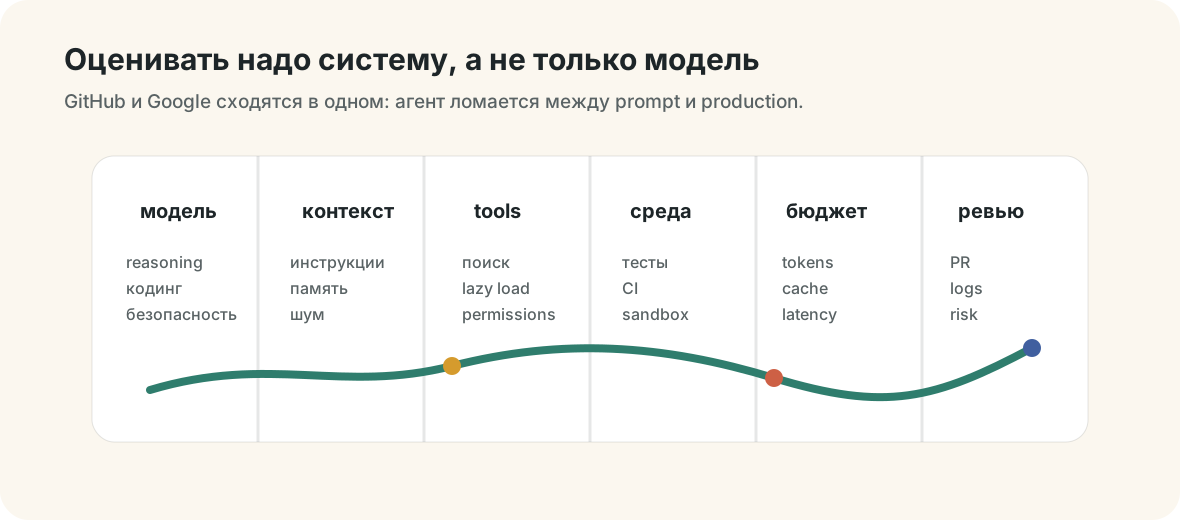
The next quality jump is not just a stronger model. It is a better loop around the model.
Vercel AI SDK 7: Production Plumbing
Vercel released AI SDK 7 on June 25. The release is full of details that matter once agents stop being demos: file references, skill uploads, approvals, durability, and telemetry.
Repeatedly sending the same files and skills wastes money. Letting an agent call tools without approvals is dangerous. Losing a long workflow after a crash makes agents unreliable. Missing telemetry means nobody knows why cost or latency changed.
This is where production agent work is heading: less chat UI, more state, permissions, observability, and recoverable workflows.
Jalapeño: Inference Becomes Strategy
OpenAI and Broadcom unveiled Jalapeño on June 24, OpenAI's first inference processor designed around LLM workloads. OpenAI says engineering samples are already running ML workloads in the lab and the first deployment is planned by the end of 2026.
This matters because agent products are not limited only by model quality. They are limited by latency, output-token cost, capacity, and the ability to run long reasoning loops without turning every task into a luxury item.
The frontier labs are moving deeper into the stack because inference is now part of the product.
Takeaways
Choose models with access policy in mind, not benchmarks alone. Build a harness, not only an API wrapper. Treat tokens as an engineering budget. Assume Slack, Linear, GitHub, and CI will become agent runtimes. Evaluate finished work, not long plans.
The main story this week is that agents are entering the boring adult phase. They now need permissions, logs, approvals, cost controls, evaluation loops, and infrastructure. That is a good sign. Useful technology always becomes operationally annoying.
Sources: OpenAI GPT-5.6 Sol · OpenAI Daybreak · OpenAI Patch the Planet · OpenAI agents and work · OpenAI and Broadcom Jalapeño · Anthropic Claude Tag · GitHub Copilot agentic harness · Google Jules evals · Google ADK and A2A multi-agent pipeline · Vercel AI SDK 7