Held up to the light, a leaf shows its plan: a midrib runs from the stalk, side veins branch off it, finer ones off those, and the finest close up into a mesh of loops. It is the leaf's plumbing and frame at once. Coral, cracks and river basins branch alike; this layer grows them all by space colonisation.
How it works
Growth points are scattered through the shape; in a living leaf they stand for cells releasing the hormone auxin. Each point pulls the nearest vein node within the “Attraction radius”. The node takes a “Growth step” in the average direction of all the points pulling it, and a point vanishes once a vein comes closer than the “Kill distance”.
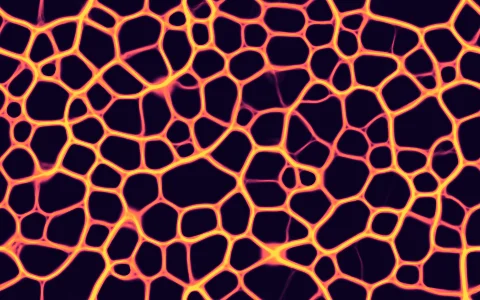
That gives open venation, a tree, as in ginkgo. In closed venation (“Closed loops”) a point pulls every vein heading its way and vanishes only when all arrive, so veins meet in loops, as in birch or maple. “Growth front” adds the points gradually: the leaf grows at its margin and the veins branch in tiers. Widths follow the pipe model.
A bit of history
Leonardo da Vinci noted that the branches of a tree at any height add up to the thickness of the trunk: branching preserves the cross-section. In 1926 the physiologist Cecil Murray derived a cube law for blood vessels: minimising the work of pumping and of maintaining the blood makes the parent's r³ equal the sum of the branches' r³. In 1964 the Japanese ecologists Shinozaki, Yoda, Hozumi and Kira described a tree as a bundle of pipes, each feeding its share of foliage. In 2005 Adam Runions, Przemysław Prusinkiewicz and co-authors reproduced leaf venation with a simple model: auxin from the growth points carves its way to the nearest veins. Two years later the same method grew tree crowns.
What to tweak
- Toggle “Closed loops”: off, a branching ginkgo leaf; on, a mesh that survives damage, as water flows around a vein a caterpillar has bitten through.
- “Taper” near 0.55 gives Murray's law, near 0.83 Leonardo's rule, and 0 veins of even width.
- “Shape” “whole frame” with 3–6 “Roots”: veins rise from the bottom edge like roots, lightning or rivers.
- “Colouring” “by branching order” uses the Strahler order, as hydrologists rank rivers.
- Being vector, it exports to SVG for a plotter or laser cutter; the “Relief” effect on top embosses the leaf.
 Reaction–diffusion
 Physarum
 Cellular automata