Under a magnifier, the background of a banknote turns out to be a net of hundreds of fine lines weaving into rosettes. The same net covers watch dials, cigarette cases and the gold beneath the enamel of Fabergé eggs. This is guilloché: engraving cut by a machine rather than a hand.
How it works
A rose engine is a lathe whose spindle rocks as it follows a cam, the rosette. As the work turns, the cutter moves in and out and cuts a closed wavy line; then the work is turned by a tiny angle and the line is cut again. A hundred shifted copies cross and shimmer with moiré.
The “rosette” figure does exactly this. Its nested rings are the “Bands”; each holds “Lines”, copies of one wave shifted in phase. The wave runs between the band's edges, which ripple round the circle as many times as there are “Lobes”. “Loops” sets the waves per lobe, “Amplitude” how deeply the edges ripple.
The “hypotrochoid” and “epitrochoid” figures are the spirograph: a wheel of radius r rolls inside or outside a ring of radius R, with the pen at distance d from its centre. If R : r is the reduced fraction P : Q (“Lobes” : “Loops”), the curve closes after Q trips round the ring and has P lobes. The “epicycles” figure adds up three rotations, as in Ptolemy's astronomy; all their frequencies leave remainder 1 when divided by the number of lobes, which guarantees the symmetry. Such curves were studied by the mathematician Frank Farris.
A bit of history
Ornamental lathes appeared in the 16th and 17th centuries, cutting ivory and wood, and moved on to gold and silver in the 18th. In 1840 the background and border of the first postage stamp, the Penny Black, were made on a rose engine to foil forgers; guilloché has guarded banknotes and passports ever since. From the 1880s Carl Fabergé laid translucent enamel over engine-turned metal, so the cutting shimmers beneath it like silk. The Spirograph toy was shown by the British engineer Denys Fisher in 1965.
What to tweak
- For the “hypotrochoid”, make “Lobes” and “Loops” coprime, say 13 and 5, for one long unbroken curve.
- Push “Amplitude” above 0.5 and the spirograph grows loops: the pen now sits beyond the wheel's rim.
- Raise “Lines” towards a hundred and lower “Line width” for moiré like real engraving.
- The “border” figure is the straight-line engine: the same waves along a straight line.
- Put the “Relief” effect on top in “metal” mode and the rosette becomes an engine-turned watch dial.
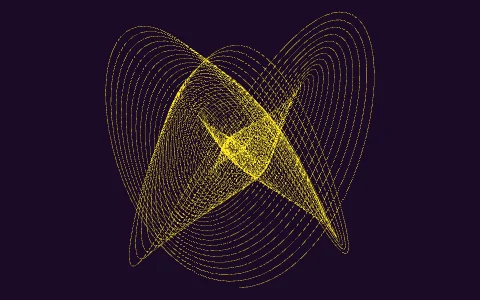 Harmonograph
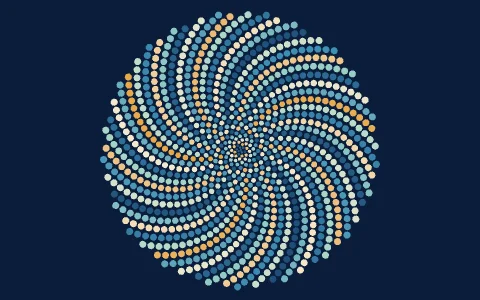 Phyllotaxis
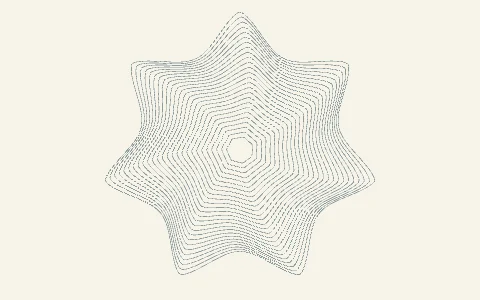 Gielis superformula
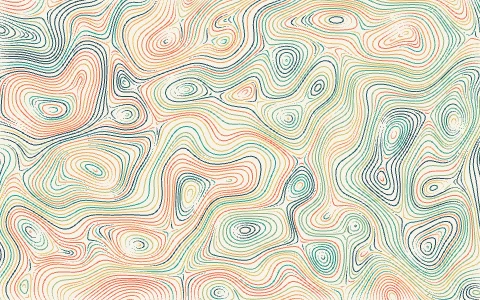 Flow lines
 Ridgelines